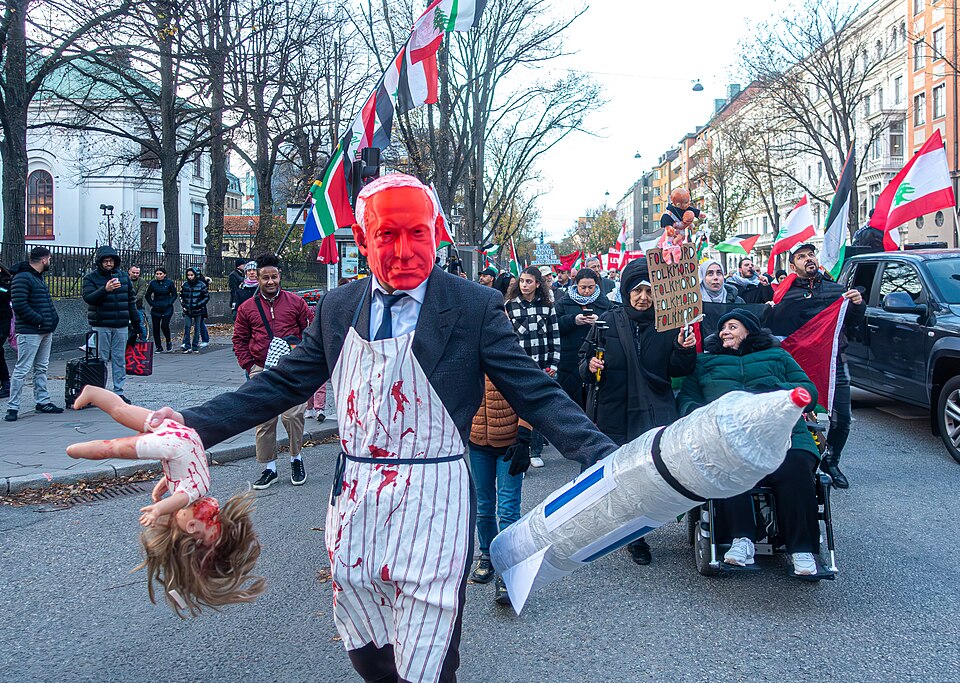
BUTCHER(S) OF GAZA
“Butcher(s) of Gaza” is a phrase aimed at Israeli leaders and military officials, and sometimes at American officials tied to support for Israel. Its purpose is to present civilian deaths in Gaza as deliberate slaughter. The word asks none of the questions the law of war asks. It does not ask whether a strike was lawful or whether the target was military, whether precautions were taken or whether Hamas fought from civilian sites. In place of all that, it hands the reader an image: butcher. That is exactly where its power lies.
The word is not a legal term, and it needs nothing a legal term would require—no case file, no tribunal, no rule of evidence, no proof of intent. It converts a disputed battlefield record into a portrait of bloodlust. The audience is never asked to weigh distinction or proportionality, command responsibility or hostage recovery, tunnel warfare or Hamas’s use of civilian cover. The conclusion arrives before the inquiry opens. And the word travels easily, which is part of its design.
It can start with Benjamin Netanyahu and then slide outward—to Israeli soldiers, to American presidents, to university trustees and donors, to Jewish organizations and Jewish students accused of defending or normalizing Israel. Somewhere along that path the word stops naming a particular person and starts assigning blood guilt by association. That drift from a named leader to a whole community is the heart of the matter. A word built for a head of state ends up pinned to a Jewish freshman at a campus rally. The distance between those two targets is where the trouble lives.
The phrase gained wide international reach in late November 2023, when Turkish President Recep Tayyip Erdogan said Netanyahu would be remembered as the “butcher of Gaza.” On December 4, 2023, Reuters reported Erdogan calling Netanyahu “the butcher of Gaza right now” and vowing he would be tried as such, with a comparison to Slobodan Milosevic. A head of state had handed the phrase diplomatic weight, and protest movements picked up the vocabulary within days. From a presidential podium it moved to the street, and on the street it found a permanent home. In demonstrations and online activism the phrase usually rides alongside images of blood and dead children, war-crimes language and demands for prosecution. It is often paired with “child killer,” “genocide,” or “war criminal,” and the pairing is telling. “War criminal” at least gestures toward a legal standard that could in principle be met or refuted. “Butcher” gestures toward nothing of the kind. It invites the listener to picture cruelty as the motive and to skip the part where motive has to be shown.
The word has also moved into campus materials. In 2025, The New York War Crimes, a protest publication tied to Writers Against the War on Gaza, ran a piece titled “Dismantle the Board of Butchers!” that bound university trustees to imperialism and Zionism and genocide. That October, the American Jewish Committee, the American Council on Education, Hillel International, and the Association of Governing Boards warned that the campaign was branding trustees as “butchers” with calls to “break the butchers” and “dismantle the board of butchers.” The shift is worth marking. The word no longer attached only to Israeli officials. It had reached the governing boards of American universities.
The wider protest climate after October 7 helps explain why all of this landed. The ADL’s 2024 report on anti-Israel activism on U.S. campuses counted 2,637 incidents of assault and vandalism, harassment and protests and divestment resolutions between June 1, 2023 and May 31, 2024. The ADL cautioned that the category mixed antisemitic conduct with anti-Israel activity that is not always antisemitic, so the figure should be read with that caution and not as 2,637 antisemitic incidents. Stated carefully, it still describes an environment in which the butcher charge could spread fast and far. The number sets the scene without settling every question inside it.
The implication underneath the word is that civilian deaths in Gaza flow from an Israeli intent to kill civilians, not from urban warfare against Hamas. That is a grave claim, and grave claims require proof. Civilian death by itself does not prove unlawful targeting, and an unlawful strike in one instance does not prove a general policy of massacre. These distinctions are not pedantry; they are the difference between a tragedy and a crime, and between a crime and a campaign of extermination. The butcher label was built to keep that difference out of view.
It also pushes Hamas out of the picture. Hamas has a documented habit of operating from or beside civilian sites—schools and mosques, hospitals and apartment blocks, and the tunnel network dug beneath crowded neighborhoods. The NATO Strategic Communications Centre of Excellence, West Point’s Lieber Institute, and Israeli government sources have all described this pattern, though claims about any specific site still deserve case-by-case checking. A careful argument can fault Israeli conduct and still acknowledge that Hamas’s way of fighting changes both the legal and the factual picture. The butcher word almost never allows that complication. It needs the battlefield emptied of everyone but the accused.
So the phrase carries more than fury. It smuggles in a whole theory of the war: that Israel kills because killing Palestinians is the aim. Once a listener accepts that premise, legal analysis turns into an afterthought and every civilian death becomes fresh confirmation. The theory feeds on the very evidence that ought to test it. The word builds a closed loop, and closing the loop is the point.
The word itself is old, common in antiwar speech, and not antisemitic on its face, and it has been hurled at generals and heads of state of every description. In Jewish contexts, though, it strikes a deeper and uglier chord, because hostile movements have for centuries tied Jews to blood and slaughter and ritual murder. The Konitz affair of 1900 is one grim precedent. In Konitz, Prussia—now Chojnice, Poland—an eighteen-year-old named Ernst Winter was found murdered and dismembered, and antisemitic agitators and newspapers steered suspicion onto the local Jewish community. The accusation settled on Adolph Lewy, a Jewish butcher, and the riots that followed were severe enough that the Prussian army had to step in. No Jew was ever convicted, and Helmut Walser Smith’s The Butcher’s Tale shows how an ordinary trade became, in antisemitic hands, a vehicle for the fantasy of Jewish bloodlust.
The modern Israel-related version surfaced most prominently after the 1982 Sabra and Shatila massacre. The killings were carried out by Lebanese Christian Phalangist forces while Israeli troops controlled access to the camps. Israel’s Kahan Commission found that the Phalangists bore direct responsibility and that Israel bore indirect responsibility, and it held Defense Minister Ariel Sharon personally responsible for failing to foresee and prevent the danger, recommending he leave the Defense Ministry. Sharon was never found to have ordered or carried out the massacre. Yet the labels “Butcher of Beirut” and “Butcher of Sabra and Shatila” compressed that careful, layered finding into one red image. By the time of the Gaza wars the word was sitting on the shelf, ready for reuse, and after October 7 it came down fast—the same old move of reducing a hard legal record to a picture of Jewish or Israeli bloodlust.
Once attached, the word lifts the war out of legal analysis and stages it as pure condemnation. A legal claim can be tested; a blood image is far harder to answer. If a speaker has already decided an Israeli leader is a butcher, evidence becomes beside the point and any rebuttal sounds like a defense of murder. The word also doubles as a loyalty test, and in campus settings the test is sharp. A student who refuses to say it can be cast as indifferent to Palestinian suffering, and a Jewish student who notes that Hamas bears responsibility too, or that intent must be proved and not assumed, can be painted as a protector of butchers.
The newer campus use against trustees adds one more function: it widens the circle of the guilty. Board members and donors, administrators and students all get folded into the same indictment, on a logic that is brutally simple—if an institution invests in or works with firms linked to Israel, then its decision-makers are butchers too. In this way a word first aimed at wartime commanders becomes a weapon inside ordinary American civic life. The same pressure reaches international institutions, where ICC warrants and war-crimes arguments and state referrals all require evidence of specific crimes. The butcher chant manufactures an atmosphere in which the conclusion is expected before any process has run, and an audience taught to resent the very demand for proof.
Israeli conduct is not beyond scrutiny, and it is important to say so plainly. Civilian deaths in war demand investigation, and some strikes may well prove unlawful on examination. The objection is narrower and firmer: the word butcher is not that investigation and cannot substitute for it. War-crimes law runs on rules of distinction and proportionality, precautions and command responsibility, intent and knowledge—and the slur swaps every one of those rules for a picture. That trade makes it emotionally powerful and analytically worthless. And its tendency to slide from Netanyahu to soldiers to Zionists to Jewish students is not a side effect but the danger itself, the moment a slogan about a war becomes a suspicion about a people.