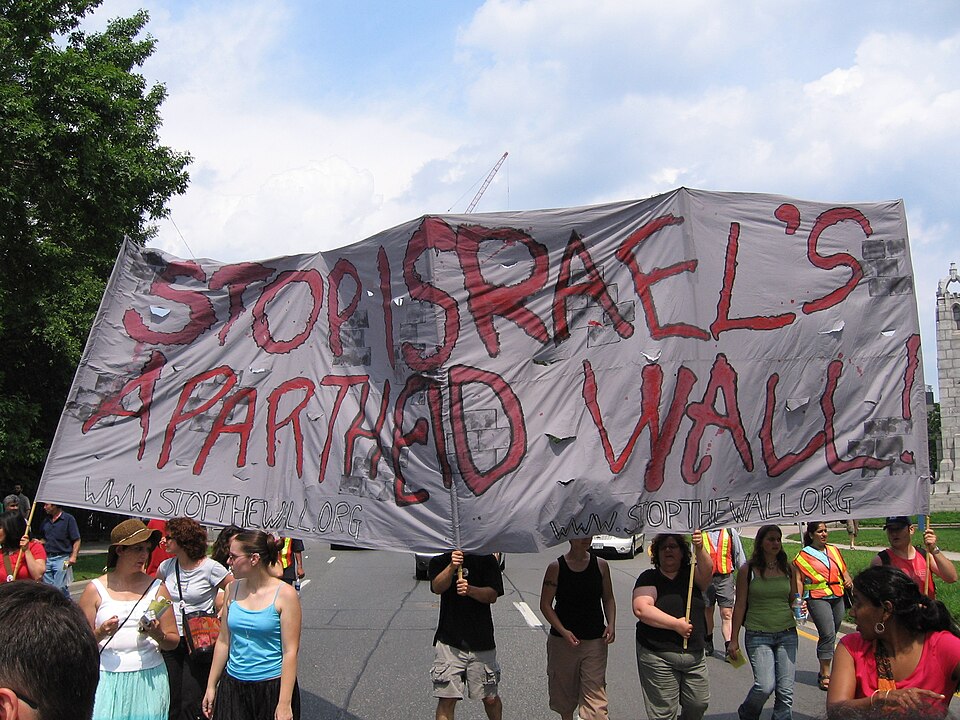
APARTHEID WALL
“Apartheid Wall” is the antizionist name for Israel’s West Bank security barrier, approved by the cabinet in June 2002 at the height of the Second Intifada. Despite the name, the barrier is not one long concrete wall. It is a system: fences along most of the route and concrete slabs near cities, with patrol roads and ditches and monitored crossings filling out the rest. The slogan picks the most dramatic image and makes it stand for everything. Attaching “apartheid” then turns a security project into a monument of racial supremacy. Two words deliver the conclusion before any of the history—why it was built, where it runs, what it costs Palestinians—gets a hearing.
The barrier exists to stop attackers from crossing out of the West Bank into Israeli cities, and that context is not a footnote. In a 2004 Washington Institute brief, IDF Col. Zohar Palti wrote that before the northern section was finished, 35 successful suicide attacks traced to Nablus and Jenin had killed 156 Israeli civilians. Once that section stood, attacks from the same area fell sharply. The barrier was not the only reason—intelligence work and arrests and raids mattered too. Still, the claim that it had no serious security purpose does not survive the record. None of this settles every question about the route, and it erases neither Palestinian hardship nor the farmland cut off from its owners. It does mean “Apartheid Wall” is no neutral description. It is a conclusion dressed up as a name.
The phrase circulates through campus demonstrations and NGO materials as a fixed compound noun, as if “apartheid wall” were simply what the thing is called. Mock walls have gone up at universities across North America and Europe and Australia, usually during Israeli Apartheid Week. The displays present the barrier as South Africa’s heir and rarely mention the suicide bombings that preceded construction. The audience sees the concrete and never hears about the buses. For the movement, that is the whole idea.
On July 9, 2004, the International Court of Justice issued an advisory opinion called Legal Consequences of the Construction of a Wall in the Occupied Palestinian Territory. The court found that building the barrier in occupied territory, including East Jerusalem, ran contrary to international law. It called on Israel to halt construction and dismantle the completed sections there, and to compensate those harmed. The vote was 14 to 1, with Judge Thomas Buergenthal dissenting. That opinion is now a stock citation in BDS materials, quoted as though it closed the case. It did not. An advisory opinion is exactly what it sounds like—advice requested by the UN, not the outcome of a lawsuit in which two countries argue their full evidence. Israel declined to participate, on the ground that the court never had the security facts needed to judge fairly. Even Buergenthal’s lone dissent endorsed nothing about the route. His objection was simpler: the court had reached an answer without the evidence required to give one.
In UN and NGO usage the phrase often appears without quotation marks, as though it were plain description, and that is precisely the point. Once the name becomes ordinary, the accusation inside it becomes ordinary too. The implication is that Israel built the barrier to cage Palestinians by race, not to stop attackers. The reader is invited to see it as kin to South Africa’s machinery—different in scale, perhaps, but not in kind. Holding that picture requires pushing the Second Intifada out of mind, even though the cabinet approved construction in the middle of a bombing campaign against buses and cafés. Memory is the first casualty of the slogan.
The phrase also inherits the South African ending. Apartheid was not adjusted at the margins; it was torn down. If Israel’s barrier is an apartheid wall, the demanded remedy is not a better route or fairer gates or compensation—it is demolition, and not only of the barrier. A security measure becomes proof that the Jewish state is criminal in form, and a route dispute becomes a case against the country itself. The selectivity shows by comparison. After Hamas seized Gaza in 2007 and hundreds of thousands of Palestinians breached the Gaza-Egypt border in January 2008, Egypt moved to fortify its own frontier. David Schenker reported that Egypt planned a Gaza border barrier with $23 million in American assistance and expected advice from the Army Corps of Engineers. Egyptian foreign minister Ahmed Aboul Gheit, who had earlier criticized Israel’s barrier, said, “Whoever wishes to build a security fence on his land is free to do that.” No slogan attached itself to Egypt’s project, and no mock Egyptian walls appeared on college quads. The contrast is telling: the phrase was never chiefly about barriers. It is about Israel.
The expression took hold during the first construction phases in 2002 and 2003, but the language was waiting in storage. The Israel-South Africa comparison had circulated through Soviet and Arab League diplomacy throughout the Cold War. UN General Assembly Resolution 3151G grouped Zionism with South African racism and Portuguese colonialism in 1973, and Resolution 3379 declared two years later that Zionism was “a form of racism and racial discrimination.” The General Assembly revoked that resolution in 1991; the language survived the funeral. The 2001 Durban Conference gave the comparison a fresh face, with an NGO Forum declaration calling Israel a “racist, apartheid state” and demanding boycotts on the South African model. When the barrier rose into view a year later, activists had the phrase ready and at last a photograph to go with it. The barrier did not create the apartheid comparison. It gave the comparison a picture.
The 2004 ICJ opinion then borrowed authority, since activist usage absorbed an opinion about the barrier’s legality into the much larger apartheid charge. The result is a phrase with layers, fusing Cold War diplomacy and Durban activism, courtroom language and campus theater, all into two words. What those two words accomplish is compression. A dispute involving terrorism and military necessity, genuine Palestinian hardship and review by Israel’s own courts, shrinks into a single image that judges before it informs. The phrase also sorts people. Saying “Apartheid Wall” announces acceptance of the South Africa comparison and everything bolted to it, while saying “security barrier” or “fence” risks being read as denial. The wording itself separates insiders from suspects. And the name moves the argument from policy to crime: if the barrier is an apartheid wall, those who build or fund or defend it are not mistaken about security—they are accomplices. That is why the phrase keeps company with demands for sanctions and boycotts and academic exclusion. It was never meant to fix a route map. It was meant to accuse and condemn.
Israel’s own Supreme Court never treated the barrier as untouchable. In Beit Sourik Village Council v. Government of Israel, the Court accepted that security could justify construction but refused to let the route serve political annexation. It struck down sections where the harm to Palestinian villagers outweighed the security gained and ordered the path redrawn. A racist monolith does not get redrawn by the country’s own judges. The barrier still caused real hardship—restricted movement, communities cut off from farmland and clinics, gates and permits imposed on daily life. Defending Israel does not require denying any of that. It requires explaining why the barrier went up and how its route should be judged, and saying plainly why a security measure in a violent conflict is not Afrikaner race law.