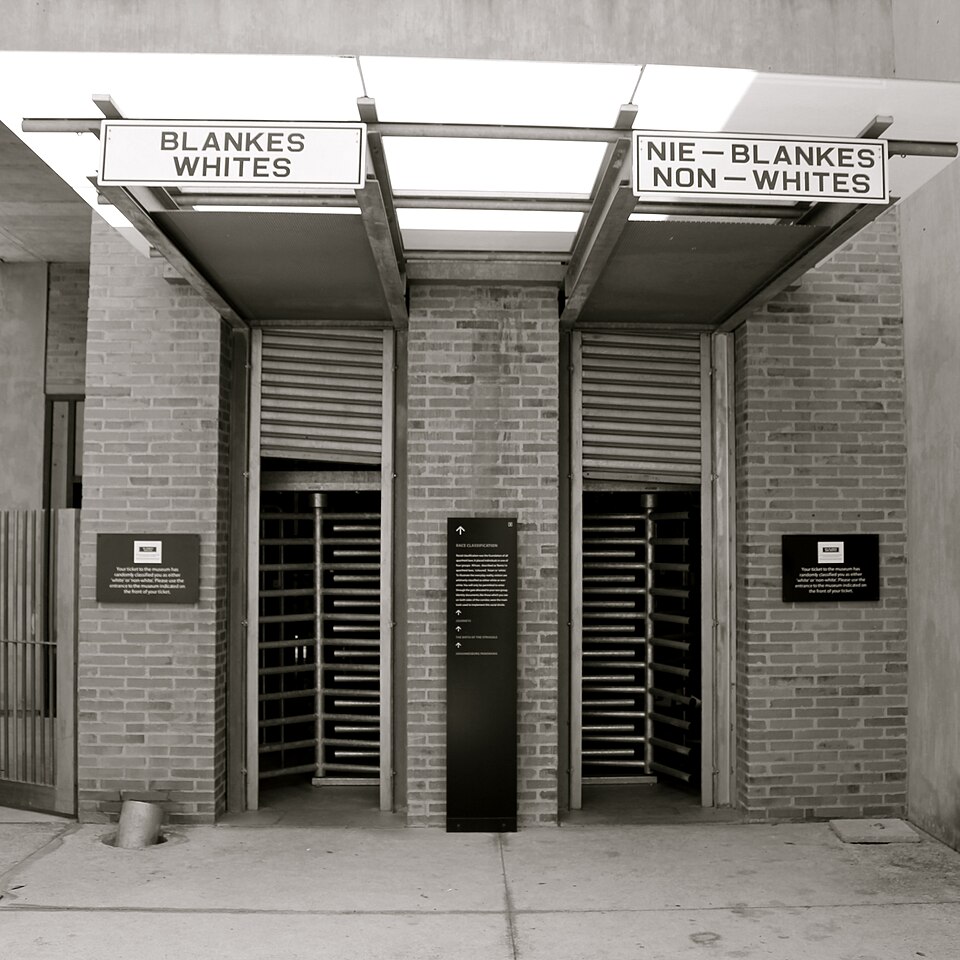
APARTHEID
In South Africa, apartheid was a race-based legal order that governed the country from 1948 to 1994. White minority rule rested on segregation and pass laws. The state classified every citizen by race, and that classification decided where a person could live and work. Black South Africans were denied the vote and forced off their land. The Afrikaans word means “separateness,” and the system earned the name. That history is specific and documented. Modern antizionism lifts the word out of its setting and aims it at Israel—and this is no ordinary criticism. It places the Jewish state beside one of the most condemned governments of the twentieth century. Checkpoints become pass laws. Security measures born of war become proof of racial supremacy. The judgment precedes the trial.
The comparison survives only by flattening nearly eight decades of history. It ignores the Oslo II Accord of 1995, which Israeli and Palestinian leaders signed and which divided the West Bank into Areas A, B, and C. It strains hardest inside Israel’s pre-1967 borders, where Arab citizens vote in national elections and serve in the Knesset. They sit as judges and teach in universities. They practice medicine and build businesses. By Israel’s own count in April 2026, Arab citizens numbered 2.157 million—21.1 percent of the country. Grafting Afrikaner rule onto a dispute over land and nationhood also blurs a basic line: Palestinians in the territories are not Israel’s Arab citizens, yet the charge treats them as one population. It pushes borders and terrorism out of view, along with rejected negotiations and the choices of Palestinian leaders. Here is a simple test for telling antizionism apart from criticism of Israeli policy. Criticism names a policy and proposes an alternative; demonization condemns the state itself. Calling Israel an apartheid state fails the test, because it names no specific law and offers no workable remedy.
The word is now standard fare on campuses and in NGO reports, and it circulates through activist coalitions and UN bodies. Israeli Apartheid Week began in Toronto in 2005, the work of the Arab Students’ Collective at the University of Toronto. It has since grown into an international event tied to boycott and divestment campaigns, complete with mock walls and panels and student-government resolutions. Human rights organizations have adopted the charge in formal reports. Human Rights Watch’s A Threshold Crossed (2021) accused Israeli authorities of the crimes of apartheid and persecution. Amnesty International’s Israel’s Apartheid Against Palestinians (2022) went further and applied the accusation to everything at once—Israel proper and East Jerusalem, the West Bank and Gaza, even Palestinian refugees abroad. That sweep sounds comprehensive. In practice it assumes what it set out to prove, and it erases every distinction that matters: citizen and resident, occupied territory and Hamas-run enclave, Israeli law and refugee life abroad.
Within the United Nations the word appears in reports and speeches as settled fact. The Human Rights Council uses it, and so does the Special Rapporteur for the Palestinian territories. The case is treated as already proven. On campus the word fuels divestment resolutions and faculty open letters and campaigns to shut Israeli scholars out. It hands antizionists a single noun that does triple duty: criminal accusation, historical analogy, demand for punishment. That is why it travels so well.
Some numbers help here. One study of the Second Intifada counted 148 suicide bombers by July 2005, and their attacks killed 657 people and injured 3,682. The West Bank separation barrier rose during those years, built to stop bombers from reaching Israeli cities. Racial separation had nothing to do with it. The charge also forgets what followed Israel’s withdrawal from Gaza in August 2005, when the country dismantled every settlement and pulled out every soldier. Hamas answered with rockets—roughly 2,700 Qassam-type rockets between September 2005 and May 2007 by Human Rights Watch’s count. By January 2009 the U.S. Congressional Record put the figure above 6,300 rockets and mortars aimed at Israeli towns since the withdrawal. A racial caste system does not hand back territory; a country under fire defends itself. The accusation cannot explain this sequence of events, so it ignores it.
The deeper implication comes from the analogy itself. The world’s consensus on South African apartheid held that the system could not be reformed—only dismantled. Transfer that judgment to Israel and the logic follows on its own. If Israel is racist by nature, no policy change will do, and the only acceptable remedy becomes the end of the Jewish state. Once accepted, the analogy also confirms itself. A new barrier becomes fresh proof, and so does a checkpoint or an emergency regulation. Every security measure gets folded back into the original charge, which makes the claim impossible to test. David Hirsh identifies this circularity in Contemporary Left Antisemitism as a recurring habit of antizionist argument. The word becomes less a conclusion than an engine for producing new ones.
The Israel-apartheid comparison has a paper trail, and it is older than the campus protests that made it famous. Its roots lie in Cold War diplomacy run by the Soviet bloc and the Arab League, with help from their Third World allies. The goal was Israel’s international isolation. The first recorded use arrived with an irony almost too precise to invent: in 1961, South African prime minister Hendrik Verwoerd—an architect of apartheid itself—reportedly accused Israel of practicing it. Israel had just voted at the United Nations to condemn South Africa’s racial policies, and Verwoerd was returning fire. Antizionists later flipped that moment into a standing weapon. In 1965 the PLO Research Center published Fayez Sayegh’s pamphlet Zionist Colonialism in Palestine, which described Zionism as a racially exclusive settler-colonial project. It compared the movement to Europe’s empires and handed later activists a ready-made script.
The Soviet Union turned the charge into a Cold War export aimed at newly independent African and Arab states, and the campaign bore fruit at the UN. General Assembly Resolution 3151G (1973) condemned what it called the “unholy alliance between Portuguese colonialism, South African racism, Zionism and Israeli imperialism.” Two years later came Resolution 3379, the campaign’s most notorious product, declaring that “Zionism is a form of racism and racial discrimination.” The General Assembly revoked it in 1991, but the language it normalized never left. The modern legal version took shape at the 2001 World Conference Against Racism in Durban, where the NGO Forum declaration called Israel a “racist, apartheid state” and demanded measures modeled on the campaign against South Africa. The BDS movement, launched four years later, drew much of its arsenal from that document. Over the next two decades activists worked the 1973 Apartheid Convention and the Rome Statute’s 1998 definition of the crime into briefs against Israel. By the time international courts took up related claims in the 2020s, the groundwork was six decades deep.
In academic life the word doubles as a loyalty test. Jewish students and scholars who keep any tie to Israel meet it as a demand for denunciation. That demand reaches most diaspora Jews, for whom Israel is part of family and faith and communal memory. The accusation also produces a curated version of the conflict. It dwells on Israeli power while saying little about Hamas rule in Gaza or Palestinian Authority administration in the West Bank. Rejected peace offers barely appear, and neither do the attacks Israel was answering. Selectivity has a purpose. If Israel is a racist state, dead Israeli civilians become casualties of the system instead of victims of murder. After October 7, 2023, that logic surfaced in the open, when antizionists in several Western cities described the Hamas massacres not as atrocities but as resistance against an illegitimate state. The apartheid charge had prepared the ground for those words to be said out loud.
Arab citizenship is a standing counterexample, which is why the argument usually hurries on to the West Bank and Gaza. The judiciary is part of that counterexample: Justice Khaled Kabub, an Israeli Arab Muslim, joined the Supreme Court in 2022. Israel is not without flaws, and the occupation of the West Bank raises real and arguable questions about rights and land and movement. Economic gaps and policing disparities are real and documented, and so are planning disputes and social tensions involving Arab citizens. These are the ordinary troubles of a diverse democracy, not the racial machinery of Afrikaner rule. Conflating the two insults the victims of the real thing and misreads Israeli life at the same time.
The accusation also keeps Palestinian governance off the page. A resident of Ramallah does not vote in Israeli elections because he is not an Israeli citizen, not because Israel sorts him by race; the West Bank and Gaza carry their own arrangements, with Areas A and B under Palestinian Authority jurisdiction and Gaza under Hamas since 2007. Israel is held responsible for every condition of Palestinian life while Hamas and the Palestinian Authority fade into the scenery. Since October 7, 2023, that asymmetry has grown harder to miss. The organizations demanding Israeli accountability under this heading have had far less to say about how Hamas treats Gaza’s own civilians.