END THE OCCUPATION
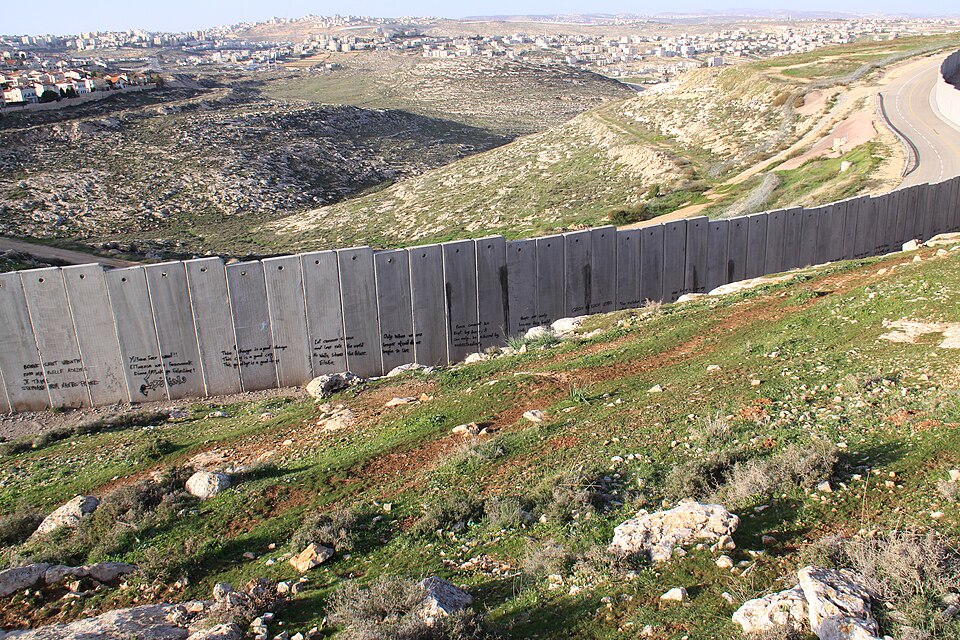
“End the occupation” is an antizionist demand to terminate Israeli control beyond the 1949 armistice lines, above all in the West Bank and East Jerusalem. In its narrower use the phrase points to Israeli military administration and settlements, checkpoints and barriers and the security control that followed the Six-Day War of June 1967. In its broader use it keeps expanding until Israel itself becomes the occupation. The slogan’s power lies in that elasticity, because a listener can take it for a modest territorial request while the speaker may mean something total. Telling the two apart is the whole task of this entry.
In international humanitarian law, occupation is defined through effective control. Article 42 of the 1907 Hague Regulations says territory is occupied when it is “actually placed under the authority of the hostile army,” and the Fourth Geneva Convention addresses cases of partial or total occupation. The ICRC, the United Nations, and the International Court of Justice apply this law to the West Bank, including East Jerusalem, and the ICJ’s July 19, 2024 advisory opinion declared Israel’s continued presence in the occupied Palestinian territory unlawful. That is the dominant international position, and an honest entry states it plainly. The disagreement begins with what the word is then made to carry.
Israel disputes the de jure application of the label while generally accepting that humanitarian rules apply in practice. The Israeli position rests on the prior status of the land: Jordan controlled and annexed the West Bank after the 1948 war, but only a small number of states recognized that annexation. Israel captured the West Bank from Jordan in June 1967, after Jordan entered the war, so on this account the territory was not taken from a recognized state and is better called disputed territory whose final status must be settled by agreement. The Oslo II Accord of 1995, signed by Israel and the PLO, divided the West Bank into Areas A, B, and C and left the permanent-status questions for negotiation. The slogan usually skips that treaty record entirely.
The phrase runs through BDS materials and campus divestment resolutions, faculty letters and NGO reports and protest chants. The 2005 Palestinian civil-society BDS call demands that Israel end “its occupation and colonization of all Arab lands and dismantle the Wall,” wording often presented as a tidy post-1967 demand. Yet the same call also demands full equality for Arab citizens of Israel and a right of return for Palestinian refugees. Those further demands show the campaign is not confined to the West Bank. It takes the whole national settlement of Israel as the object of pressure.
The word also appears in arguments that deny Israel the right to defend itself at all. At a November 2023 American Muslims for Palestine convention in Chicago, CAIR Executive Director Nihad Awad said, “Israel, as an occupying power, does not have that right to self-defense.” Awad later said his remarks concerned international law and that targeting civilians is never acceptable. Even so, the line shows the work the label can do: once Israel is classed as an occupier, its military response to Hamas gets recast as the suppression of resistance instead of the defense of civilians. The category does the arguing before any fact is examined.
The slogan also carries a history it prefers to forget. At the Arab League summit in Khartoum on September 1, 1967, shortly after Israel captured the West Bank and Gaza, Sinai and the Golan Heights, Arab leaders declared “no peace with Israel, no recognition of Israel, no negotiations with it.” That came before the settlement enterprise took its later shape. Israel’s own June 1967 cabinet discussions included a willingness to return Sinai and the Golan in exchange for peace with Egypt and Syria, while the West Bank question stayed unresolved. The slogan compresses that diplomatic record into something far simpler: Israel occupies, therefore Israel must leave.
In its narrow form, “end the occupation” implies that Israeli withdrawal from the West Bank would resolve the conflict, or at least remove its central cause. That argument has to reckon with the Gaza precedent. In 2005 Israel dismantled all 21 settlements in Gaza and pulled out its soldiers, completing the evacuation of bases and personnel on September 12, 2005, and formally cancelling its military government there. International bodies still dispute whether Gaza remained occupied because of Israeli control over airspace, sea access, crossings, and the population registry, and that dispute is real. But the security outcome is also real: withdrawal was followed by Hamas’s 2006 election win, its 2007 seizure of the Strip, escalating rocket fire, and the build-up that preceded October 7.
The lesson is not that withdrawal is impossible. It is that withdrawal without demilitarization, enforceable security guarantees, and a durable agreement can produce a hostile armed enclave instead of peace. Gaza is the warning case, written in plain sight. A slogan that demands exit without saying who governs afterward, who disarms Hamas and Palestinian Islamic Jihad, who controls the borders, and who prevents rearmament is not a peace plan. It is an instruction with the hard parts deleted. Naming those hard parts is precisely what separates a serious proposal from a chant.
In its broader form, the phrase implies that Israel’s very existence is the occupation, which is why it so often appears beside “from the river to the sea.” The question then is not where the 1967 lines should fall but whether a Jewish state is legitimate anywhere in the land. Ernest Bevin put the older version of this dispute plainly in the House of Commons on February 18, 1947: for the Jews the essential point was a Jewish state of their own, and for the Arabs the essential point was to resist a Jewish state “in any part of Palestine.” That was before Israel existed, before any settlements, before the West Bank or Gaza ever came under Israeli rule. The later occupation vocabulary gives an old rejection a new legal sound.
The legal language of occupation comes from the law of armed conflict, not from antizionism. Its antizionist use grew after 1967, when Arab states and Soviet propaganda networks, UN forums and Western activist circles made the captured territories the center of anti-Israel campaigning. UN Security Council Resolution 242 set out the familiar land-for-peace formula: Israeli withdrawal “from territories occupied in the recent conflict,” together with an end to belligerency and respect for every state’s right to live in peace within secure and recognized boundaries. Antizionist usage keeps the withdrawal clause and quietly drops the reciprocal peace requirement. The Soviet and Arab diplomatic campaign then tied occupation to colonialism and racism and, later, apartheid—UN General Assembly Resolution 3379 declared Zionism a form of racism in 1975, and the 2001 Durban NGO Forum gave boycott and apartheid rhetoric a wider stage. The occupation slogan did not begin at Durban, but Durban folded it into the same vocabulary as settler-colonialism and BDS.
That legal dispute over the Fourth Geneva Convention does not make every Israeli policy wise or defensible, but it does mean the slogan buries a genuine disagreement beneath a command. Eugene Kontorovich and others have argued that Israel draws a uniquely intense form of occupation-related scrutiny next to other disputed or occupied territories—Western Sahara and northern Cyprus, Nagorno-Karabakh and Abkhazia and Crimea. That comparison does not settle the West Bank question. It does explain why the word matters so much in antizionist speech: once attached to Israel, it triggers a set of demands rarely pressed with equal force anywhere else. What the phrase accomplishes is to make Israeli presence sound illegal before security, treaty text, or history is weighed at all. It shifts the argument from borders and terms to guilt and exit, and once occupation is accepted in its most expansive sense, Israeli soldiers stop defending Israelis and start enforcing domination, while Israeli civilians stop living in a contested national conflict and become settlers by definition. In campus and professional settings it works as a gateway demand, licensing divestment and academic boycott, disruption and exclusion and institutional loyalty tests. People are no longer asked merely whether they support a Palestinian state. They are asked whether they accept that Israel’s presence is criminal and that normal relations with Israelis should cease until the demand is met.
It also erases the rejected offers. The Clinton Parameters of December 2000 proposed a Palestinian state in Gaza and roughly 94 to 96 percent of the West Bank with land swaps; the Taba talks of January 2001 built on those ideas and still ended without agreement. Later rounds failed in turn over borders and security, refugees and Jerusalem, recognition and the end-of-claims question. The slogan compresses that long record into a single demand and leaves the reader with one responsible party. A few distinctions keep the account honest. The dominant legal position holds the West Bank, including East Jerusalem, to be occupied territory where the Fourth Geneva Convention applies, affirmed by the ICJ in its 2004 wall opinion and again in 2024, and this entry does not deny that position—it argues that antizionist use of the phrase routinely exceeds the legal point and converts a territorial dispute into a demand against a Jewish state as such. Israel’s position is not that no law applies but that the Convention does not apply de jure because the land was taken from no recognized state, while humanitarian provisions are applied de facto, which is why “disputed territory” recurs in Israeli legal argument. On Gaza, both camps can be right in their own categories—one about legal control, the other about physical withdrawal—while the security result stays relevant to any West Bank plan.
A serious discussion can ask what Israel should do in the West Bank, where the borders should run, how the settlements should be handled, and what security arrangements would be required. The slogan skips those questions and treats Israeli presence as self-evidently criminal, then offers withdrawal as the only conceivable answer. It ignores the security record that followed the last withdrawal, and Gaza is not a footnote to that record but its center. Any demand for a West Bank pullout has to explain how the Gaza outcome would be prevented alongside Israel’s main population centers, only a few miles away. Most of all, the phrase hides its maximalist version inside its moderate one. Many listeners hear “end the occupation” as a call to leave the West Bank, and the ambiguity is useful precisely because it lets the words sound like support for two states while functioning, in many rooms, as a demand for the end of the Jewish state.