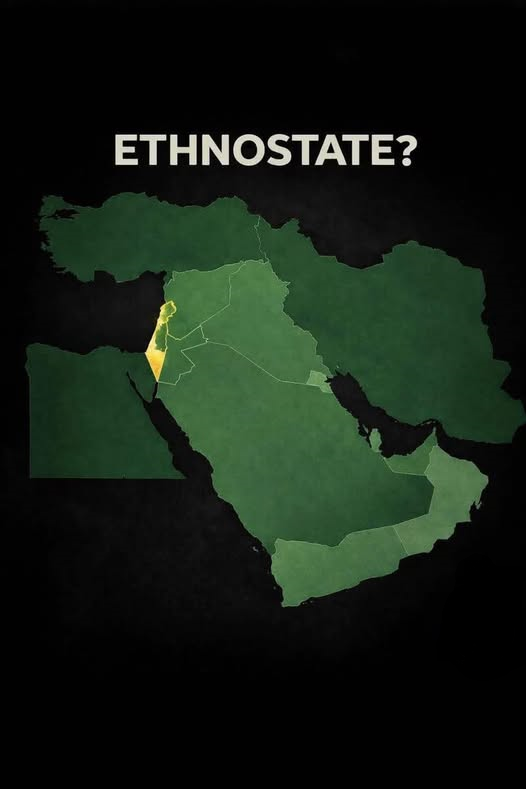
ETHNOSTATE
“Ethnostate” is used in contemporary antizionist speech to present Israel as a country built for Jews at everyone else’s expense. The word usually gestures at the Law of Return and Jewish national symbols, Hebrew and the 2018 Nation-State Basic Law, and Israel’s unresolved conflict with Palestinians in the West Bank, Gaza, and East Jerusalem. It compresses all of that into one charge: that a Jewish state is racist by its very design. The term carries force because it sounds like a neutral description while bearing the stigma of racial rule. That mismatch between its clinical surface and its toxic payload is what makes it effective.
In ordinary English after Charlottesville, “ethnostate” calls up white-nationalist dreams of a racial homeland. Applied to Israel, the same word drags Jewish self-determination into that field of association. A state founded as a refuge after centuries of expulsions and pogroms and the Holocaust is made to sound like a racial project modeled on exclusion. The problem is not that Israel lacks a Jewish national character, because it plainly has one—the Law of Return, Jewish public holidays, Jewish symbols, Hebrew civic life, and a constitutional commitment to the Jewish people. The problem is that “ethnostate” is far too crude to describe the legal and civic facts. Israel is a Jewish-majority state with democratic institutions and formal citizenship rights for Arab citizens, alongside real minority disadvantages, disputed territories, and a long war with enemies who have often rejected a Jewish state anywhere in the land. Compressing that mixed record into a single word turns it into a racial charge it cannot bear.
Serious scholarship tends to reach for sharper terms. Sammy Smooha described Israel as an ethnic democracy, Yoav Peled examined Israeli citizenship through liberal, republican, and ethno-national strands, and Oren Yiftachel used “ethnocracy” to analyze land, borders, and unequal access to power. These terms are debatable, but each is more exact than “ethnostate.” The latter is not a recognized category in Freedom House, V-Dem, the Economist Intelligence Unit, or Polity. Its usefulness in antizionist speech lies less in precision than in the damage it can do.
The word grew common in anti-Israel commentary after the Nation-State Basic Law passed in July 2018. That law declares Israel the nation-state of the Jewish people, names Hebrew the state language, calls Jewish settlement a national value, and states that national self-determination in Israel is unique to the Jewish people. Critics read it as proof that Israel had placed Jewish nationality above civic equality. Supporters answered that the law cancelled no individual rights, no voting rights, and no Arab citizenship, and that other Basic Laws and ordinary statutes still protect civil rights. The disagreement was real, and the word “ethnostate” arrived to settle it by fiat.
The term grew easier to deploy after the November 2022 election, when Netanyahu’s coalition took in hard-right religious-nationalist parties. During the 2023 court crisis, critics used “ethnostate” to name the fear that weaker judicial review would leave minorities less protected. After October 7 and the Gaza war, it appeared beside apartheid and settler-colonialism, genocide and Jewish supremacy, in campus protests and faculty letters, NGO commentary and online campaigns. The word also draws power from American racial politics, where it is bound tightly to white nationalism and the alt-right, so applying it to Israel makes the Jewish state sound like a Jewish version of white separatism even when the speaker has no idea where the word came from. The implied claim is that Israel’s Jewish features are not national features at all but instruments of ethnic domination. The Law of Return becomes racial exclusion. Hebrew and Jewish symbols become supremacy. The Nation-State Law becomes proof that non-Jews are permanent outsiders. Checkpoints in the West Bank, border controls around Gaza, settlement growth, and the disadvantages facing Arab citizens all become evidence of one seamless Jewish order. That reading depends on a series of mergers—Arab citizens of Israel folded together with West Bank Palestinians, Gaza Palestinians with East Jerusalem residents, Israeli civil law with Palestinian Authority administration and Hamas rule and military control and refugee claims, all blended into a single claim about Israel’s internal nature. Those distinctions are not excuses. They are the only way to know what is actually being judged.
Arab citizens of Israel are not foreigners within Israel. They vote and hold Knesset seats, run parties and serve as judges, study in universities and work in hospitals and litigate in court. In 2021, Ra’am joined the Bennett-Lapid coalition, which the Israel Democracy Institute describes as the first time an Arab party was a formal member of an Israeli government. In 2022, Khaled Kabub, an Arab Muslim judge, joined Israel’s Supreme Court. Discrimination is real, and so are the land and planning disputes, the budget gaps, and the failures of crime and policing. It does show why “ethnostate” fits poorly if the word is meant to denote racial caste. The demographics complicate the label further: Israel’s April 2026 Independence Day statistics put the population at 10.244 million, including 2.157 million Arabs, or 21.1 percent. A state with a large Arab citizen minority, Arab parliamentary parties, and Arab judges does not match the ordinary meaning of a pure exclusionary racial state. It can still be criticized as an imperfect Jewish democracy, but that is a different and far more modest claim.
The Law of Return is the strongest card critics hold, since it gives Jews a path to immigration based on Jewish connection. Yet diaspora-return laws are not unique to Israel; many states grant preferred citizenship to members of a historic people or national kin group. Israel’s case stands out because Jewish history stands out—exile and statelessness, genocide, and the absence of any other Jewish refuge. To call that history racial privilege without naming the history that produced it is not analysis. The word’s own lineage is instructive. The Oxford English Dictionary traces the earliest known use of “ethnostate” to a 1985 glossary by Fred W. Riggs, where it was merely descriptive and carried none of its later charge. It darkened through white-nationalist writing: Robertson’s The Ethnostate, composed between 1985 and 1992, used the term for a white racial homeland, and later figures including Spencer made it public shorthand for racial separatism. By the time it reached mass debate after the 2017 Charlottesville rally, it no longer sounded technical. It sounded supremacist. Anti-Israel usage draws on a related but distinct line, since scholars of Israel and Palestine had long debated Jewish statehood and ethnic democracy, ethnocracy and citizenship and minority rights—Smooha, Peled, Yiftachel, Rouhana, Ghanem, Hirschl and others offered serious critiques of Israeli civic life. Antizionists took the harsher public word and pinned it to Israel, producing something simpler and more damaging than the scholarship the concerns came from. Beneath that sits an older polemic: Soviet and Arab nationalist writing that treated Zionism as racism or colonialism, given international status by UN General Assembly Resolution 3379 in 1975. The resolution was revoked in 1991, but its logic outlived it. “Ethnostate” is a newer word for the same old move—recasting Jewish self-determination not as a nation’s right but as racism by definition.
In practice the term makes Jewish statehood sound disqualifying. Once Israel is an ethnostate, the argument drifts from specific law and policy to the country’s basic character, and boycott and divestment, academic and cultural exclusion, arms embargoes and diplomatic isolation all start to sound like anti-racist duties instead of coercive measures aimed at the one Jewish-majority state. The word also turns ordinary national features into evidence of guilt. A flag bearing a Jewish symbol, an immigration law, Jewish holidays, Hebrew, and state concern for Jews abroad become suspect in a way the same features rarely do elsewhere. That selective treatment is exactly the double standard flagged by Natan Sharansky’s 3D test and by several definitions of antisemitism, however much those definitions differ on other points. It is simply easier to say “ethnostate” than to ask the separate questions that honesty requires—about Arab citizens of Israel, about Palestinians in Areas A, B, and C, about East Jerusalem residents, about Gaza under Hamas, about refugees, about settlement policy and court review and citizenship law. Precision weakens the slogan, which is precisely why the slogan resists precision.
A few specifics keep the account honest. The Nation-State Basic Law should be quoted with care: for all its symbolic weight, it does not say Arab citizens cannot vote, hold office, litigate, or serve. Israel has no single written constitution, so its Basic Laws, ordinary statutes, Supreme Court rulings, and democratic practice must be read together, and the Nation-State Law is one important part of that whole, not the whole itself. Arab citizens have both formal rights and documented disadvantages, and both belong in the record—denying the disadvantages weakens the defense of Israel, while denying the rights makes the ethnostate claim easier than the facts allow. The West Bank and Gaza raise real but separate questions: West Bank Palestinians lack Israeli citizenship because the area has not been folded into Israel’s ordinary civil order, and Gaza Palestinians have lived under Hamas since 2007, so neither can serve as simple proof of Israel’s domestic citizenship model. Freedom House’s 2026 report rates Israel Free at 73 out of 100 and assesses the West Bank and Gaza separately—a separation that itself reflects the very distinction the ethnostate label is built to erase.
The deeper objections follow from all this. The word substitutes stigma for definition, because its meaning shifts from speaker to speaker—sometimes racial caste, sometimes a nation-state with a majority of people, sometimes a state with a diaspora-return law, sometimes any state with a religious or ethnic national identity. A term that slides that far is not doing careful work. It mistakes Jewish self-determination for racial rule, when the Jewish state grew not from a fantasy of mastery but from Jewish peoplehood and ancestral connection, modern nationalism, persecution, and the collapse of Jewish safety across Europe and the Middle East. It merges populations whose legal status genuinely differs, which makes the slogan easier and the analysis worse. And it is applied to Israel with unusual intensity, while the many countries that have established religions, majority national identities, ancestry-based citizenship, or high ethnic homogeneity are rarely branded with the same word and the same institutional pressure. That selective application is not incidental. It is the source of the term’s appeal.