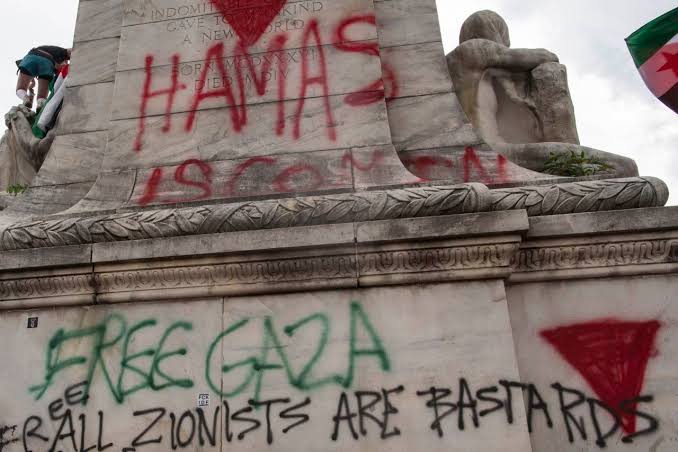
FREE PALESTINE
“Free Palestine” is not antisemitic in every use. It can mean Palestinian self-determination, civil rights, or a negotiated state alongside Israel. In a good deal of antizionist use, though, the phrase works differently. It is an elastic demand with its content left blank, so that moderate listeners hear rights while radicals hear removal. Everything depends on what Palestine is being freed from.
If the answer is military rule in the West Bank, Hamas rule in Gaza, Palestinian Authority repression, corruption, poverty, or statelessness, the slogan can point toward ordinary civic claims. If the answer is Israel’s existence as a Jewish state, it becomes a denial of Jewish self-determination. The ambiguity is old. The Palestine Liberation Organization was founded in 1964, before Israel controlled the West Bank or Gaza. The 1968 Palestinian National Charter then described armed struggle as the route to liberating Palestine, called the 1947 partition and the establishment of Israel illegal, denied that Jews constitute a nation, and rejected any substitute for the total liberation of Palestine. The modern slogan does not recite those articles, but it inherits a vocabulary in which liberation frequently meant replacing Israel instead of building beside it.
Context is what settles the meaning. At a peace rally, in a human-rights report, or inside a two-state argument, the words may mean Palestinian independence. At a campus encampment that also chants “from the river to the sea,” at a rally outside a synagogue, or during an attack on Jews or Israelis, they carry a different force. The trouble is not the word “free.” It is the unresolved object of liberation.
Since October 7, 2023, “Free Palestine” has turned up across campus encampments and street protests, social media and graffiti, clothing and concert stages and institutional statements. The ADL describes the phrase as widely used by people advocating Palestinian rights and notes that many users intend no support for extremism or violence. The same source records that, since October 7, the phrase has been used in numerous cases to intimidate or attack Jews and Jewish institutions. It has also surfaced in lethal contexts. In the May 21, 2025 attack outside the Capital Jewish Museum in Washington, D.C., Yaron Lischinsky and Sarah Milgrim, both Israeli Embassy employees, were killed after leaving an American Jewish Committee event. According to the February 2026 superseding filing summarized by the Justice Department, Elias Rodriguez allegedly fired about twenty shots and called out “Free Palestine.” The Justice Department also stated that he displayed a red keffiyeh inside the museum and said, “I did it for Palestine. I did it for Gaza.” A second attack followed on June 1, 2025, targeting a Run for Their Lives gathering in Boulder, Colorado, held to draw attention to the Israeli hostages in Gaza. The Justice Department says Mohamed Sabry Soliman approached the group with Molotov cocktails and shouted “Free Palestine” while throwing one of them, and the later federal case alleged hate-crime counts and described a handwritten document calling Zionism an enemy until Jerusalem is liberated and Jews are expelled from the land. These attacks do not define every use of the slogan. They do explain why Jews often hear the phrase differently from the way many activists say they mean it, and why that hearing rests on evidence.
The slogan’s force depends on a sentence it leaves out: free Palestine from what? In much antizionist usage the answer is not Hamas, the Palestinian Authority, failed diplomacy, Arab-state rejectionism, or Gaza’s Egyptian border. The answer is Israel, and more precisely the Jewish state. That omission does real work, casting Jews and Israel as the sole jailer of Palestinian life while setting aside Hamas’s rule in Gaza since 2007, the Palestinian Authority’s authoritarian record in the West Bank, the rejected peace proposals, the regional manipulation of the Palestinian cause, and the Egyptian restrictions at Rafah. A vast regional history shrinks to one obstacle.
The blank also lets users skip the harder question of what comes after liberation. Does “Free Palestine” mean two states? A confederation? A single Arab-majority state in place of Israel? Full refugee return into Israel? The end of Zionism altogether? Different speakers give different answers, and antizionist movements gain from that looseness, because it lets the slogan travel without forcing anyone to say whether Jewish national survival is part of the future they want. Einat Wilf and Adi Schwartz argue in The War of Return that the maximalist return demand has often worked less as a refugee solution than as a means of undoing Israel through demographics. The slogan can do the same job when it promises liberation but will not say whether Jews remain a self-governing people in their ancestral homeland.
The phrase sits inside a longer liberation vocabulary. Arab nationalist leaders in the 1950s and 1960s cast Palestine as a cause of regional redemption, and the PLO gave that cause an organizational form. Its early charter language was not a post-1967 protest against settlements; it was a pre-1967 demand to liberate Palestine from Zionism and to undo the legitimacy of Israel. After 1967 the phrase moved through Third World revolutionary networks, Soviet-aligned anti-Zionist propaganda, student movements, and Palestinian solidarity campaigns, attached to anti-imperial and anti-colonial idioms that made the conflict legible to Western activists. By the 2001 Durban NGO Forum and the 2005 BDS call, Palestinian liberation language had been repackaged in the terms of apartheid and colonialism, occupation and return, equality and boycott. That history matters because “Free Palestine” sounds new to many Western users when it is not. The slogan belongs to a long campaign in which liberation has often meant more than Palestinian statehood—it has meant the removal of Zionism as a legitimate national project—and modern campus usage inherits both the rights-based appeal and the older eliminationist demand.
In antizionist spaces the phrase functions as a membership test. People are rarely asked to define it; they are asked to say it, and the saying marks who belongs in the moral community and who has to explain himself. It also compresses a dozen disputes into a single command, leaving one instruction: Palestine must be freed. And the slogan lets radicals speak through mainstream language, since a person who wants a Palestinian state beside Israel and a person who wants a Palestine in place of Israel can chant the very same words. That shared vocabulary lets the maximalist claim borrow the respectability of human-rights language while keeping its harder edge for audiences who already understand it.
Several specifics keep the lineage honest. The 1968 Palestinian National Charter is central to it: Article 5 defined Palestinians as Arab nationals who normally resided in Palestine until 1947; Article 6 counted as Jewish nationals only those who had normally resided there before what it called the Zionist invasion; Article 9 made armed struggle the path to liberation; Article 19 declared partition and Israel’s establishment illegal; Article 20 denied Jewish nationhood; and Article 21 rejected any substitute for total liberation. The slogan is context-dependent and should be treated neither as inherently violent in every use nor as harmless in every use, since its meaning shifts when it is paired with Hamas symbols, eliminationist chants, synagogue protests, or acts of violence. The IHRA working definition identifies the denial of Jewish self-determination, including the claim that Israel’s existence is a racist endeavor, as an example that may be antisemitic depending on context—a standard that bears directly on the difference between a Palestine beside Israel and a Palestine replacing it. Egypt, for its part, controls the Rafah crossing and imposes its own restrictions, yet liberation campaigns rarely make Egypt an object of protest, which says something about where the pressure is aimed. The two 2025 attacks prove nothing about every speaker, but they do show that the phrase has been cited in attacks on Jews and Israelis.
The strongest objections to the slogan follow from its evasions. A serious demand should be able to say what it wants: a state beside Israel, or a state in place of it. This one avoids the choice, and the avoidance is part of its appeal. It also frees Palestine from everyone except its own rulers, almost never confronting Hamas, the Palestinian Authority, or the Arab states that have used Palestinians as instruments, which turns Palestinian suffering into a one-cause story that leaves Palestinians trapped under leaders the slogan does not challenge. Most of all, it lets moderates and extremists stand under one banner—defended as a humane call for rights in one room, shouted at a Jewish institution in another. That is the central danger of the phrase, and it is built into the design.