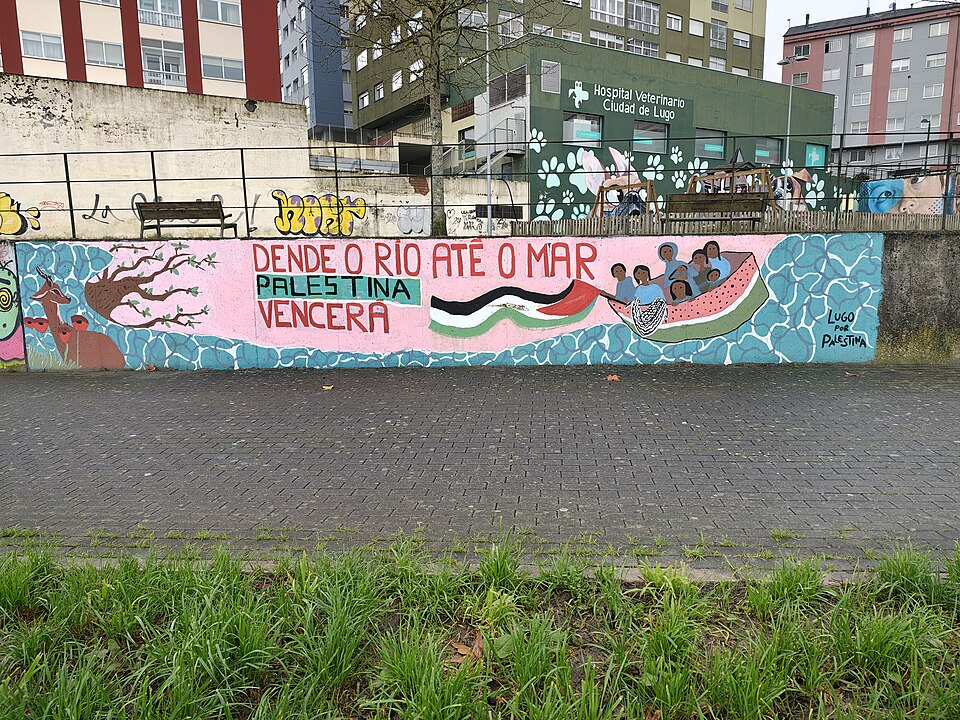
FROM THE RIVER TO THE SEA
“From the river to the sea” names the land between the Jordan River and the Mediterranean—the whole space that today holds Israel, the West Bank, and Gaza. In antizionist use it almost always arrives in full: “From the river to the sea, Palestine will be free.” The words sound geographic, like a description of a coastline. Their force is political, because the territory they describe is the territory Israel occupies, and a single free Palestine across all of it leaves no room for a Jewish state in its present form. That is why many Jews hear the chant as a demand for replacement, not a demand for rights.
Defenders give the phrase gentler readings. Some say it calls for equal rights, democratic coexistence, or an end to Israeli military rule. Those readings are sincerely held by some who chant it, and the entry does not pretend otherwise. But the geography is stubborn. Israel sits inside the named space, so a Palestine that is free “from the river to the sea” as one outcome cannot leave the Jewish state intact. The phrase is not really about Gaza or the settlements or the West Bank alone. Without a limiting clause, it reaches Tel Aviv and Haifa as surely as Hebron and Gaza City.
The origin of the exact phrase is murkier than its confident users suggest, and honesty requires saying so. The territorial idea behind it is old and well documented: the 1964 Palestinian National Charter described Palestine, within its British Mandate boundaries, as an indivisible territorial unit, and that language predates Israeli control of the West Bank and Gaza. The rhymed English chant is a different object with a shorter paper trail. The earliest clear English appearance located so far comes from the writer Fawaz Turki, whose 1980 Journal of Palestine Studies account of the 1979 Palestine Congress of North America records the line, “The people will struggle till the total liberation of Palestine from the river to the sea.” The doctrine, in other words, is decades older than any verified instance of the slogan itself. Collapsing the two into a single tidy origin story flatters the certainty of everyone who repeats it.
What is not in doubt is the territorial maximalism the phrase carries in its harder forms. Hamas put the claim in religious terms in its 1988 covenant, which speaks of raising the banner of Allah over every inch of Palestine. Its 2017 document defines Palestine as running from the Jordan River in the east to the Mediterranean in the west, rejects any alternative to full liberation, and states that the establishment of Israel created no rights for what it calls the Zionist entity. The same 2017 text mentions a Palestinian state on the 1967 lines as a formula of national consensus, but it offers that without recognizing Israel. Read together, the documents describe a claim to the whole map, and the modern chant gives that claim a softer public sound.
After October 7, 2023, the slogan became one of the most visible phrases in anti-Israel protest, turning up at street marches and campus encampments, in online campaigns and in fights over the meaning of antisemitism. It also entered formal politics. In November 2023 the House of Representatives censured Representative Rashida Tlaib in part over her use and defense of the phrase, and on April 16, 2024 the House passed H. Res. 883, declaring the slogan antisemitic, by a vote of 377 to 44 with one member voting present. The resolution called it an antisemitic call for the eradication of Israel. Forty-four members, mostly progressive Democrats, voted no, several of them arguing that the measure conflated criticism of Israel with antisemitism. The split in that vote is itself part of the phrase’s story: even its condemnation was contested.
Jewish organizations have largely read the chant as a denial of Jewish self-determination. The American Jewish Committee’s 2024 survey found that 64 percent of American Jews considered the statement antisemitic while 35 percent did not, and the Anti-Defamation League describes it as a call for a state stretching from the river to the sea that would dismantle the Jewish one. Other institutions landed elsewhere. Meta’s Oversight Board ruled in September 2024 that three Facebook posts using the phrase broke no rules, finding they expressed solidarity with Palestinians without calling for violence or exclusion or praising Hamas. That ruling settled a content-moderation question, not the meaning of the words. Platform enforcement and public meaning are simply different problems.
By 2026 the phrase had crossed from protest dispute into statute. Queensland, Australia, passed the Fighting Antisemitism and Keeping Guns out of the Hands of Terrorists and Criminals Amendment Act 2026, which wrote a prohibited-expression offence into the state criminal code. The law names both “from the river to the sea” and “globalise the intifada” as prohibited expressions when they are publicly recited, distributed, or displayed in a way reasonably expected to make a member of the public feel menaced, harassed, or offended, subject to listed reasonable-excuse provisions. The phrase, in other words, is no longer only a slogan or a piece of history. In some jurisdictions it has become a legal object, and its meaning now varies by where it is spoken.
The central move the slogan makes is territorial compression. It erases the line between Israel inside its pre-1967 armistice boundaries and the territories captured in 1967, and once that line is gone the demand no longer stops at ending military rule in the West Bank or changing Gaza policy. It reaches the entire state. A speaker may sincerely intend a single democratic state with equal rights for all, yet even that version asks Jews to accept that their collective self-rule is uniquely illegitimate in the one place it was restored after exile and persecution and genocide. The phrase functions, in the end, as replacement by implication. The speaker need not say “end Israel,” because the map says it for him: if the land between the river and the sea is to be one Palestine, Israel is not on it. That silence is the whole device. It also works as a loyalty test in protest spaces, where refusing to chant the line can mark a person as suspect, sorting insiders from outsiders and turning a dispute over borders and recognition into a public test of belonging. Not every speaker need be treated as an extremist. It requires only noticing what the words describe, and being honest that the gentlest interpretation and the harshest one arrive at the same place on the map.