GLOBALIZE THE INTIFADA
“Globalize the Intifada” calls for the intifada to spread beyond Israel and the Palestinian territories. The Arabic word intifada means a shaking-off, an uprising. In Palestinian history it refers above all to two named campaigns: the First Intifada that began in 1987 and the Second Intifada that began in 2000. The second included suicide bombings and shootings, stabbings and lynchings and mass-casualty attacks against Israeli civilians. That history rides along with the word whether a given speaker means it to or not.
The two uprisings were not the same. The First Intifada involved strikes and demonstrations, stone-throwing and riots, and some fatal attacks. The Second was far deadlier, with suicide bombings against buses and restaurants, city streets and hotels and clubs. The ADL summarizes that period as one in which Palestinian violence turned into terrorism aimed squarely at Israeli civilians, leaving more than 1,000 Israelis dead and thousands severely wounded. So the slogan is not merely a request that the world notice Palestinian suffering. It asks listeners to universalize a campaign that lives, in Jewish and Israeli memory, alongside bombed buses and cafés and a Passover seder massacre. Not everyone who repeats it knows that history or intends every part of it, but a word does not turn harmless because some of its users prefer the gentler translation.
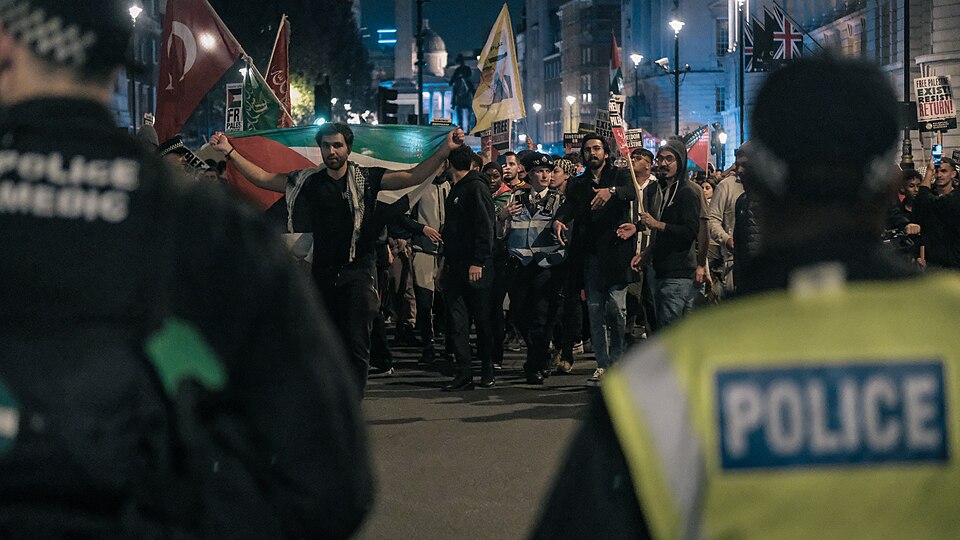
After October 7, 2023, the phrase spread through anti-Israel demonstrations in the United States and Britain, Australia and across Europe. It appeared at street protests and campus encampments, on placards and social-media graphics, in chants outside Jewish or Israel-linked sites. Its public use grew contentious because it does not only name Palestinian liberation; it names a method of confrontation already tied to civilian fear. The phrase reached a major American hearing on December 5, 2023, when Representative Elise Stefanik pressed Harvard President Claudine Gay about campus calls for “intifada” and “intifada revolution.” Gay called the rhetoric personally abhorrent but declined to give the categorical answer Stefanik sought about whether it broke Harvard’s bullying and harassment rules. The exchange became one of the clearest cases of institutional hesitation over anti-Jewish intimidation after October 7.
The fear attached to the phrase can be measured. The American Jewish Committee’s State of Antisemitism in America 2025 Report found that 88 percent of U.S. Jews said seeing or hearing “Globalize the Intifada” would make them feel unsafe to some degree, with only 12 percent saying it would not. The AJC describes the phrase as a call for aggressive resistance against Israel and its supporters, and notes that most American Jews read it as encouraging violence against Jews, Israelis, and those who back them. Whatever the intent of any single speaker, that is how the audience most affected by it hears it. The slogan gained law-enforcement weight after major attacks abroad. In November 2024, supporters of the Israeli club Maccabi Tel Aviv were attacked in Amsterdam; Reuters reported that Mayor Femke Halsema called the attackers “antisemitic hit-and-run squads” while also noting anti-Arab conduct by some Maccabi fans before the match. On December 14, 2025, gunmen killed 15 people at a Hanukkah celebration at Bondi Beach in Sydney, opening fire with shotguns and a hunting rifle on hundreds of people, according to the Associated Press. New South Wales then moved to ban “globalise the intifada,” with the state government calling it hate speech and an encouragement of violence. In Britain, the Metropolitan Police and Greater Manchester Police announced on December 17, 2025 that anyone using the phrase at future protests or in a targeted way should expect police action and arrests, saying the context had changed, that words carry consequence, and that officers would use public-order powers, including around London synagogues during services.
The implication of the phrase is that the battlefield is everywhere. Once the intifada is globalized, the line between Israeli soldiers and Jews abroad gets harder to hold, and a Jewish student or a synagogue, a community center or an Israeli soccer fan or a company with Israeli ties can be folded into the same enemy network. This is why mapping projects and targeted protest materials matter. In November 2023, Within Our Lifetime briefly posted maps of New York Jewish organizations and said they had “blood on their hands”; the New York Jewish Week reported that the group calls for intifada and Israel’s destruction, and that the posts drew NYPD attention and public condemnation. The Boston Mapping Project had supplied a template in 2022, naming hundreds of organizations and closing, according to the ADL, with the line that every entity has an address and every network can be disrupted.
The phrase also pushes Jewish fear outside the circle of sympathy. When Jews say it sounds like a threat, they are often told they misunderstand Arabic, or fear Palestinian freedom, or confuse criticism of Israel with antisemitism. That answer dodges the actual problem, which was never the dictionary meaning of a single Arabic word. The problem is the history attached to the word and the settings in which it is now aimed at Jews. The slogan depends on the prestige of revolutionary language and the convenience of an ambiguous translation. The contemporary phrase takes that conflict history and turns it outward. Earlier protest language stayed focused on Palestine itself, with “Free Palestine,” “End the Occupation,” and “From the River to the Sea.” “Globalize the Intifada” goes further, asking supporters not merely for a change in Israeli conduct but for the export of the struggle. It sits inside an older antizionist habit of treating Jewish institutions abroad as proxies for Israel: Soviet propaganda portrayed Zionism as a worldwide system, and Arab nationalist and Islamist literature often cast it as a global enemy. The slogan distills those habits into a single instruction—make the struggle local, wherever Jews and Israel-linked institutions can be found.
In practice the phrase turns Jewish institutions and Israeli-linked events, Zionist speakers and synagogues, campus Hillels and businesses and cultural groups into local fronts in a worldwide fight. It also supplies deniability. Challenged, a speaker can insist that intifada only means uprising or resistance or liberation; shouted in a crowd after October 7, or displayed near a Jewish building, it carries a harsher charge. That ambiguity is the useful part, letting the slogan sound poetic to outsiders while sounding like a threat to Jews who remember what the Second Intifada did. Governments and police have increasingly treated the ambiguity as a safety question, with New South Wales moving to prohibit the chant after Bondi and the British forces saying they would arrest people who used it in targeted settings. Those decisions are contested on free-speech grounds, especially where protest protections are broad, and the disagreement is legitimate. The legal fight itself, though, confirms the core point: the phrase no longer reads as a neutral expression of solidarity, and is now widely understood as language capable of intimidation.
A few cautions keep the analysis honest. The phrase should not be read through literal translation alone, because “intifada” has both a dictionary meaning and a conflict history. Not every speaker intends suicide bombings or attacks on Jews, yet that does not close the question, since public slogans are judged by history and context and foreseeable effect, not by private intent alone. The Amsterdam and Bondi examples have to be handled with care, because they do not prove that any chant causes an attack—they show why Jewish communities and public authorities began treating calls to globalize the intifada as a concrete safety concern. The strongest objection is not that the phrase criticizes Israel. It is that the phrase carries the memory of civilian targeting into Jewish life far from Israel, and that it uses the language of resistance to license intimidation, defended as poetry when challenged and heard as permission when shouted in a crowd.