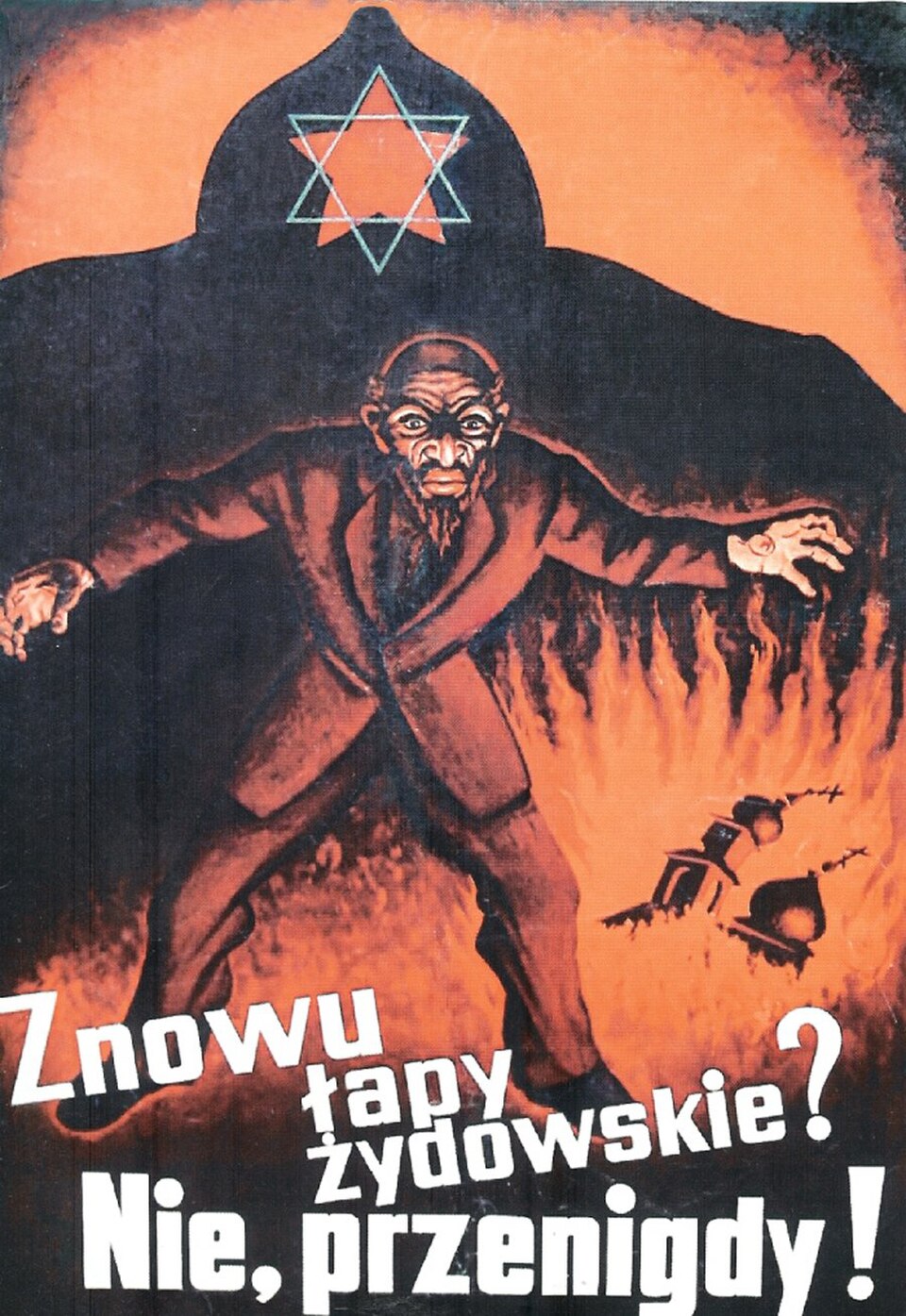
JEWISH SUPREMACY
“Jewish supremacy” is a label used in anti-Israel and antizionist writing to cast Israel as a system built to privilege Jews over Palestinians. It is not an invented phrase. B’Tselem used it in 2021 in the title of its paper, “A regime of Jewish supremacy from the Jordan River to the Mediterranean Sea: This is apartheid,” and Adalah, the Legal Center for Arab Minority Rights in Israel, uses related language in its legal and advocacy work. The phrase draws its force from its resemblance to white supremacy, and that resemblance is the whole point. The label has a narrower use and a broader one. Narrowly, it makes a legal claim about Israeli rule and the West Bank, about settlements and East Jerusalem and Gaza, about the Nation-State Law and land policy and the unequal treatment of Palestinians, all subjects that can be argued on their own evidence. Broadly, in antizionist hands, it does something else: it treats Jewish national self-determination as domination in itself. The problem is no longer one law or one border or one government. The problem becomes the Jewish state precisely because it is Jewish. That is the move that matters. A serious critique can point to civic inequalities, to unresolved territorial disputes, to settlement abuses or discriminatory land practices or a flawed Nation-State Law. “Jewish supremacy” tends to convert those particular disputes into a single status judgment—that a Jewish state is racism by definition—and that conversion is why the phrase belongs in this glossary.
The term entered high-profile NGO usage before the Gaza war that began in October 2023. B’Tselem’s 2021 position paper argued that the whole area between the Jordan River and the Mediterranean is organized around one principle, the advancement of Jewish supremacy over Palestinians, and Adalah’s materials on the Nation-State Law say the statute enshrines Jewish supremacy over Palestinian citizens of Israel. After October 7 the phrase spread through campus protest and BDS material, social media and teach-ins and faculty letters, usually traveling beside apartheid and settler-colonialism, ethnostate and Zionist racism. In that company it is rarely confined to one disputed law or one corner of the West Bank. It becomes shorthand for Zionism itself. The phrase also lends anti-Israel activism a familiar American grammar, since white supremacy is one of the clearest civic evils in American life, and transferring that grammar to Zionism gives the claim instant force. The listener is no longer asked to weigh whether a specific Israeli policy is lawful. The listener is asked whether to oppose supremacy.
The implication is that Jewish collective rights are different in kind from the collective rights of other peoples. National symbols and a national language, a Jewish immigration preference, Hebrew calendar references, Jewish holidays, and concern for the diaspora are treated not as ordinary features of a nation-state but as evidence of racial hierarchy. Israel’s 2018 Nation-State Basic Law is the strongest source critics have. It declares Israel the nation-state of the Jewish people, says the right to national self-determination in Israel is exclusive to the Jewish people, names Hebrew the state language while giving Arabic special status, holds the state open to Jewish immigration, and calls Jewish settlement a national value. Critics can reasonably argue that the law should have carried an explicit equality clause and that its settlement language grows dangerous when applied across the Green Line.
The leap from those criticisms to “supremacy,” though, is not automatic. Israel also has Basic Law: Human Dignity and Liberty, which protects human dignity and liberty and states that its purpose is to anchor the values of Israel as a Jewish and democratic state. Basic Law: The Knesset provides that every Israeli citizen of eighteen or older may vote unless a court has removed the right under law. Arab citizens vote and run parties, sit in the Knesset and serve in government coalitions, argue before the courts and sit on them. Justice Khaled Kabub became the first Muslim member of Israel’s Supreme Court in 2022, and Ra’am joined the Bennett-Lapid coalition in 2021, the first time an Arab party was a formal member of an Israeli government. Inequality is real, and naming it does not require the word supremacy; the facts limit the claim. A country with Jewish national institutions and Arab civic participation is not usefully described in the same vocabulary used for systems that deny the minority the vote, bar it from the courts, or build the law around a permanent civic caste. The sharper, fairer criticism is that Israel holds a real tension between Jewish national rights and minority equality. “Jewish supremacy” collapses that tension into a single word.
The phrase draws on two well-worn vocabularies, the American civil-rights language of white supremacy and the South African anti-apartheid language of racial domination, and in Israel-related use it also grows from the older “Zionism is racism” tradition. Soviet and Arab-state campaigns after 1967 treated Zionism as racial domination and pushed that wording into UN forums, most notoriously Resolution 3379 in 1975, which was repealed in 1991 even as the vocabulary survived. A second line runs through Israeli and Palestinian human-rights organizations, as Yesh Din and B’Tselem and Adalah increasingly adopted apartheid and supremacy language in the years around 2020. Their strongest evidence usually concerns the West Bank—settlement rule and movement restrictions, differential legal systems, land use, and the constitutional symbolism of the Nation-State Law. Once the phrase leaves a legal report, it sheds its qualifications. The careful distinctions among Israel proper and East Jerusalem, the West Bank and Gaza, refugees and Arab citizens and noncitizen Palestinians and Jewish Israelis tend to vanish, and what remains is the slogan: Zionism equals supremacy.
The phrase functions, then, as a disqualification device. It tells the audience that Zionism need not be debated, because it has already been filed under the category reserved for racial domination, and once that filing is accepted, ordinary contact with Israel can be redescribed as complicity with supremacy. It also shifts the burden onto Jews. A Jewish student or scholar, an artist or donor, a synagogue or Hillel chapter or Israeli speaker can be asked to prove distance from Zionism before being treated as acceptable. The question stops being “what do you think about this policy?” and becomes “will you reject Jewish supremacy?”—which makes support for Jewish national self-determination sound like support for racial hierarchy. The phrase is especially useful because it slides between softer and harder meanings. Challenged, the speaker can say it refers only to unequal Israeli policy; in movement use, it often means that a Jewish state is illegitimate as such. The same words carry both senses, which is why they travel so easily.
B’Tselem and Adalah are the strongest direct sources for the phrase, and they earn it the way the slogan never bothers to, which is with evidence: both tie the claim to named laws, land policy, and movement rules a reader can go and check. The campus version keeps the conclusion and quietly drops the proof. And the label survives only as long as no one counts the Arab Israelis already inside the system. Israel’s Supreme Court seated Khaled Kabub—a Muslim judge who had spent decades on the Tel Aviv District bench—as its first permanent Muslim member on May 9, 2022, filling a retiring justice’s seat through the regular appointments committee. Ra’am, an Islamist party led by Mansour Abbas, became the first independent Arab faction to sit in a coalition on June 2, 2021, trading its votes in the Knesset for billions of shekels aimed at Arab towns. A system built on permanent caste does not hand the people it keeps at the bottom a ballot, a robe, and a chair at the cabinet table. None of this clears a single Israeli policy; it just makes “supremacy” the wrong word for the complaint.
The charge is also not homegrown. It descends from a Cold War propaganda effort that predates every settlement and checkpoint now invoked to justify it. The UN General Assembly branded Zionism a form of racial discrimination through Resolution 3379 on November 10, 1975, after years of lobbying by Soviet and Arab-state delegations, and Israel’s ambassador Chaim Herzog tore the text apart at the podium. Sixteen years later the same body struck the language down through Resolution 46/86 on December 16, 1991, the price of bringing Israel to the Madrid peace talks. The wording outlived its own repeal and returned, almost unchanged, in the chants heard at today’s protests.
Several objections follow, and they reinforce one another. The first is that the phrase borrows the language of white supremacy and treats the resemblance as if it proved the case. White supremacy described a ruling caste that shut the other group out of the vote, the courts, and the schools; Israeli practice runs the other way, with Arab citizens making up roughly a fifth of the population, electing their own parties, and reaching both the cabinet and the Supreme Court. Those facts do not erase the real gaps in how Arab citizens are treated, but a system designed to keep Jews on top would not seat the minority in parliament or on its highest court. The label carries the weight of a different history without showing that the same conditions exist here. The second objection is that the phrase tends to arrive before the evidence, not after it. Once you assume a Jewish state is wrong because it is Jewish, ordinary features begin to read as proof—the Law of Return, Hebrew on official forms, the symbols on the flag—whereas the same country read without that assumption shows a vote extended to every citizen over eighteen and Arab judges ruling against government ministers. A serious complaint can name the statute and the harm: settlement rule, the missing equality clause in the 2018 law, unequal land allocation. “Supremacy” skips that specific work and reaches for the conclusion first. The third objection is simply that no other nation’s self-rule draws the same label—not Greek, not Japanese, not Irish—which points to an objection aimed at this state’s existence more than at any policy it follows.