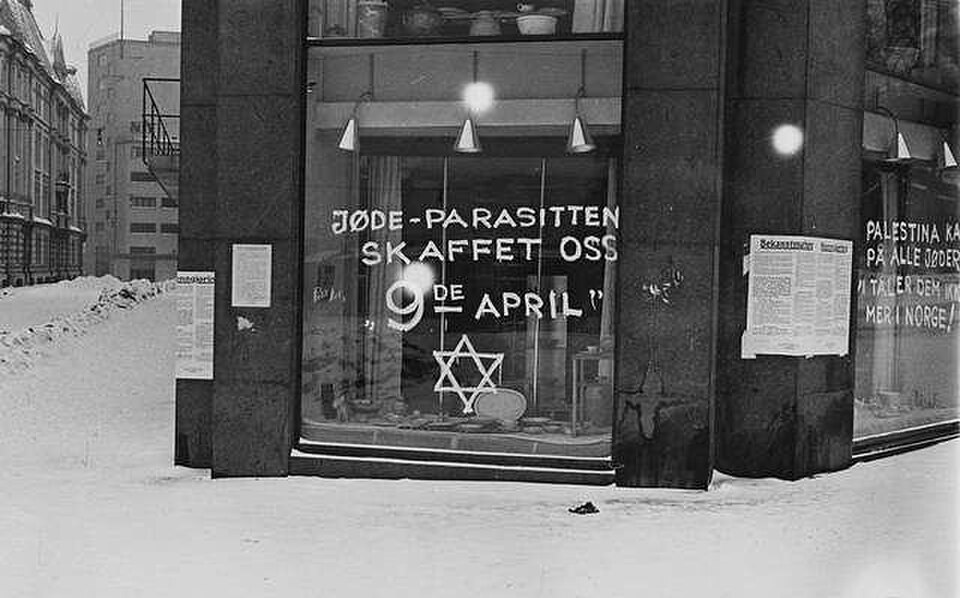
NAZI ANALOGY (MODERN-DAY NAZIS / NAZI STATE)
“Nazi analogy” reaches Israel in two grammatical forms that do the same work. One brands people: “modern-day Nazis,” aimed at Zionists, Israelis, and Jews who defend Israel. The other brands the country: “Nazi state,” aimed at Israel as an institution. The first makes individuals into heirs of the perpetrators; the second makes the state into the successor of the Third Reich. Both move past the claim that a law or a minister or a military operation is wrong, and into the claim that the thing itself—the person, or the polity—is Nazism in a new costume. They are worth treating together, because the underlying move is identical and the historical distortion is the same.
That distortion begins with what Nazism actually was. It was not a loose synonym for cruelty but a racial-totalitarian project built on dictatorship and conquest, on antisemitic law and the systematic murder of six million Jews. The United States Holocaust Memorial Museum defines the Holocaust as the systematic, state-sponsored persecution and murder of six million European Jews by Nazi Germany, its allies, and collaborators. The Nuremberg Laws of 1935 stripped Jews of citizenship and criminalized marriage and sexual relations between Jews and Germans classed as non-Jewish under race law, and Nazi racism went on to produce the industrial killing of Europe’s Jews along with millions of other victims. That is the weight the word Nazi carries. To attach it to Israelis or to Israel is therefore not criticism in any ordinary sense. It takes the central crime committed against Jews and turns it into a weapon against the Jewish state, which is why the International Holocaust Remembrance Alliance lists “drawing comparisons of contemporary Israeli policy to that of the Nazis” among its examples that may be antisemitic depending on context.
Israel, meanwhile, is a Jewish-majority country with grave conflicts and contested laws, military rule in disputed territory, deep internal inequality, and ferocious public argument. It holds elections and seats opposition parties, runs courts and grants Arab citizens the vote, places non-Jewish judges on the bench and subjects its military conduct to legal review. None of that puts Israeli policy beyond criticism. It does place the country far outside the category of Nazi Germany, and it makes the label historically false whether it is aimed at a person or at the state. The aim of the analogy was never accuracy. Its aim is reversal: the state created after the destruction of European Jewry is recast as the heir to the power that tried to annihilate the Jews, and the people who survived genocide are recast as its authors.
The label travels through chants and placards, cartoons and graffiti, online graphics and boycott materials. Israeli leaders are given Hitler mustaches, swastikas are drawn over Israeli flags, Gaza is compared to Auschwitz, and the Warsaw Ghetto is invoked as though Israeli military power and Nazi extermination policy belonged to one category. Two reference points give the pattern a precise place in the study of antisemitism. The IHRA working definition names the comparison of contemporary Israeli policy to Nazi policy as a contextual example, and the European Institute for the Study of Contemporary Antisemitism’s 2009 report on the “Nazi card” defines the problem as the use of Nazi terms or symbols in reference to Jews, Israel, Zionism, or aspects of Jewish experience. The EISCA framing is especially useful because it treats the Nazi card as a discourse—a recurring move in words and images and symbols—while still recognizing that Israeli policy can be criticized strongly without any Nazi comparison at all. The two things are separable, and serious criticism does not require the analogy.
The comparison has also moved well beyond protest art into official speech. In December 2023, Reuters reported that Turkish President Recep Tayyip Erdogan said Prime Minister Benjamin Netanyahu was “no different” from Hitler and likened Israel’s Gaza campaign to the Nazi treatment of Jews, and in May 2024 Reuters reported him demanding that Israeli leaders face a genocide trial. When a head of state reaches for the analogy, it stops being a fringe insult and becomes part of formal public conflict, normalized for audiences already prepared to hear it. The phrase tends to surge at exactly the moments that should cut against it: after October 7, 2023, the Hamas-led massacre was followed by a wave of claims that Israel had become Nazi-like through its war in Gaza, and in that setting the label did two jobs at once. It pushed Hamas’s crimes out of view by recasting Israel as the supposed new Third Reich, and it made Jewish grief after the massacre look hypocritical or staged.
The implication beneath both forms of the analogy is that Jewish power has become the new Nazism. The claim turns the Holocaust into a mirror, since Jews were once the victims of extermination and now Jews are said to have become the exterminators, and that reversal drains Jewish historical vulnerability of its meaning while recasting the Jewish state as a danger to humanity. It wounds in a way ordinary insult does not, because it tells Jews that the survival project built in the shadow of their near-destruction became the thing that murdered their families. From there it works as a permission system. If Israel is Nazi Germany, then those who support its existence can be treated as fascist sympathizers, and Jewish students and synagogues, Hillels and artists and donors and community organizations can be pressured, excluded, or threatened under the banner of opposing Nazism. The charge does not stay in the Middle East. It follows Jews into classrooms and workplaces, arts spaces and unions and professional life, until the real target is any Jew who will not disown Jewish self-determination.
The analogy also destroys the distinctions that make honest argument possible. It blurs war and extermination, battlefield harm and death camps, emergency rule and racial dictatorship, state error and state doctrine, civilian casualties and planned industrial murder. Civilian deaths in war are not death camps, military occupation is not the Nuremberg Laws, and border control is not the machinery of genocide. A serious case against any state has to name the act, the rule, the evidence, and the responsible actor; the Nazi analogy skips all of that by spending the stored horror of the Holocaust, and once it is accepted, context begins to sound like excuse-making and evidence becomes an afterthought. Asking about Hamas tunnels or hostage-taking, rocket fire or human shields or proportionality can then be dismissed as evasion. The label trains its audience to resent the very demand for facts.
The lineage is traceable, and it does not start in 2023. The Israel-Nazi comparison became central to Cold War anti-Zionist language after Israel’s 1967 victory over Soviet-backed Arab states, when Soviet propaganda set out to discredit Zionism among postcolonial and Western-left audiences by equating it with racism and fascism, imperialism and Nazism. Yuri Ivanov’s Caution: Zionism!, published in English by Progress Publishers in 1970, cast Zionism as a sinister global force tied to fascism and conspiracy. UN General Assembly Resolution 3379 did not call Zionism Nazism, but its 1975 declaration that Zionism was “a form of racism and racial discrimination” belonged to the same campaign that worked to make Zionism comparable to the century’s most hated movements; the resolution was revoked in 1991, and the vocabulary outlived it. A second channel ran through Arab public writing, including Mahmoud Abbas’s 1984 Amman book al-Wajh al-akhar: al-’alaqat al-sirriyah bayna al-Naziyah wa-al-Sihyuniyah, usually rendered as The Other Side: The Secret Relationship Between Nazism and Zionism, part of a wider effort to bind Zionism to Nazism and shift a share of the Holocaust’s guilt onto Zionists. Izabella Tabarovsky has traced how Soviet anti-Zionism borrowed from tsarist and Nazi antisemitic material, refitted it in Marxist-Leninist language, and exported it through state publishing and international networks. In that lineage the comparison never operated as careful history. It operated as role reversal, and the details changed while the reversal stayed.
What the analogy finally produces is a disqualification device. Once it is accepted, Israel no longer has to be engaged as a real country with real enemies and real failures and real security threats, because it has been filed under ultimate evil, and the filing does the work. Negotiation comes to sound indecent, security claims sound fake, and Jewish fear sounds like manipulation. It also powers boycott and exclusion, letting cooperation with Israelis be relabeled as normalization with fascism and Israeli scholars and artists and athletes be made untouchable. And it degrades the memory it borrows from, turning Auschwitz into a metaphor and the Warsaw Ghetto into a protest prop while the specific machinery of Nazi rule—racial law and one-party dictatorship, ghettos and Einsatzgruppen, deportations and camps and gas chambers—disappears, leaving the word Nazi stripped down to its power to condemn.
A few cautions keep the analysis fair. The Nazi comparison should not be confused with the historical study of the 1933 Haavara Agreement or the wartime conduct of particular actors, which serious history can examine; Holocaust inversion does something else, turning Zionism or Israel into Nazism by category. The IHRA definition does not call all criticism of Israel antisemitic, and says expressly that criticism similar to that leveled at any other country cannot be regarded as antisemitic. Nazi Germany was a racial dictatorship that destroyed democracy, stripped Jews of citizenship, waged aggressive war, and carried out genocide, so any comparison to it shoulders an extraordinary burden. And Israel can be criticized without the analogy at all—over settlement and ministers, military decisions and coalition politics, judicial disputes and religious coercion and the treatment of Palestinians—none of which requires the word Nazi.
The objections follow from the history, not from any wish to shield Israel. The analogy uses the word Nazi as a substitute for proof, setting a project of conquest and genocide beside a flawed, embattled democracy and skipping the burden of making a case. It reverses the Holocaust against the people it was built to destroy, turning the central crime committed against Jews against Jews who now hold power, which is the emotional engine of the phrase, not an accident of it. And it erases the actual Nazis, because the Holocaust was a specific crime carried out by specific people with specific laws and camps and armies and victims, and turning every hated state into Nazi Germany empties the word of meaning. In Israel’s case it does something worse still, using the crime against the Jews to delegitimize the Jews’ own state, and telling Jews that the memory of the Holocaust no longer shields them from eliminationist language but can now be turned against them.