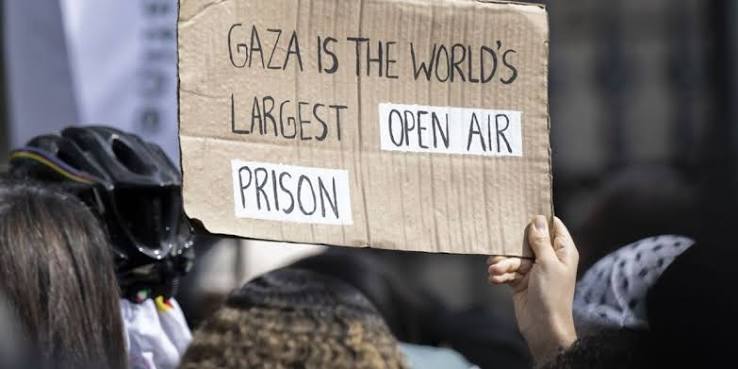
OPEN-AIR PRISON
“Open-air prison” is the antizionist name for Gaza under Israeli and Egyptian border restrictions. The phrase is powerful because it begins with a truth: civilian life in Gaza has been severely constrained. Movement has been restricted, poverty has deepened, electricity and water systems have failed, and war has damaged homes, hospitals, roads, schools, and entire neighborhoods. None of that is imaginary. The problem is what the phrase does with the suffering. It turns hardship into a prison metaphor, and the prison metaphor supplies its own conclusion. Gaza becomes a cell, Palestinians become inmates, and Israel becomes the jailer before the history is examined.
That is why the phrase travels so easily. It sounds humanitarian, visual, and morally complete. A listener does not need to know the difference between a land crossing and a naval blockade, Rafah and Kerem Shalom, dual-use restrictions and arms interdiction, Hamas rule and Israeli inspection. The image has already done the sorting. A prison has bars, guards, prisoners, and a warden. Once Gaza is named that way, every checkpoint becomes a cruelty, every inspection an act of domination, every limitation a punishment. The phrase does not ask how Gaza came to be governed, armed, blockaded, crossed, supplied, attacked, or defended. It gives the answer first.
The chronology matters. Israel withdrew its settlements and permanent ground forces from Gaza in 2005. The withdrawal did not produce peace. Palestinian armed groups fired thousands of rockets toward Israeli communities in the years that followed, and Hamas seized control of Gaza from Fatah in June 2007. Israel and Egypt then tightened their border controls. The naval blockade developed later, during the war with Hamas in January 2009. Any account that begins with the blockade but not with the withdrawal, the rockets, Hamas’s takeover, weapons smuggling, tunnel warfare, kidnappings, and later hostage-taking has already edited the file before reading it.
The phrase also erases Egypt. Gaza has more than one border. Egypt controls Rafah, has restricted movement through it, has moved against smuggling tunnels, and has demolished structures along its side of the Gaza frontier to create a buffer zone. Yet protest language almost never says “Egypt keeps Gaza in an open-air prison.” Israel is made the single actor with agency, while Egypt becomes scenery and Hamas becomes atmosphere. That selectivity is not accidental. The slogan is aimed at Jewish statehood, not at the full architecture of Gaza’s confinement.
Hamas disappears most completely of all. A prison does not govern itself. Gaza under Hamas did. Hamas ran ministries, police, courts, media, taxes, tunnels, weapons systems, and armed units. It ruled Palestinians internally while using the territory to fight Israel externally. It built military infrastructure inside civilian space, fired rockets at Israeli towns, held hostages, and treated border pressure as a political asset. To leave Hamas out is not compassion for Palestinians. It is a way of making Palestinians appear to have only one oppressor, when many have also lived under violent Islamist rule that made their lives instruments of war.
The legal record is more complicated than the slogan allows. The 2011 Palmer Report accepted that Israel faced a real security threat from Gaza and found the naval blockade lawful as a security measure. The same report criticized the land-access policy as unsustainable and called for change. That distinction is essential. A defense of the naval blockade is not a defense of every closure rule, cargo delay, permit denial, or civilian hardship. At the same time, criticism of the closure does not prove that Israel had no security reason to inspect goods, restrict dual-use materials, or prevent weapons from entering by sea. The slogan collapses precisely the distinctions that honest argument needs.
“Open-air prison” usually appears beside phrases such as “break the siege,” “open Gaza,” and “stop starving Gaza.” These words land because civilian suffering in Gaza is real and morally urgent. Their weakness is not concern for civilians. Their weakness is the refusal to say what replaces inspection, screening, and arms interdiction once the restrictions are removed. If the demand is more aid, more predictable crossings, faster medical access, and screened civilian supply, that is a policy argument. If the demand is the removal of Israeli inspection and sea control while Hamas remains armed, that is a security demand wearing humanitarian clothes.
The phrase’s function is to make security control sound like sadism. It leaves no room for the hard question: how to protect civilians in Gaza while preventing Hamas from importing weapons used against civilians in Israel. It also manufactures a false test of compassion. Anyone who supports inspection can be accused of supporting hunger. Anyone who asks about rockets can be accused of excusing suffering. Civilian access and security screening are not opposites. A serious policy has to protect both Palestinian civilians and Israeli civilians, which is exactly the balance the slogan makes difficult to think about.
In its softer use, “open-air prison” criticizes the severity of Gaza restrictions. In its harder antizionist use, it turns Gaza’s suffering into proof that Israel is criminal by nature. The shift is subtle but decisive. The subject stops being border policy and becomes the legitimacy of the Jewish state. Gaza’s hardship is real; the one-jailer story is not. The phrase works by taking an actual civilian crisis and arranging the facts so that only Israel can be seen.