PINKWASHING
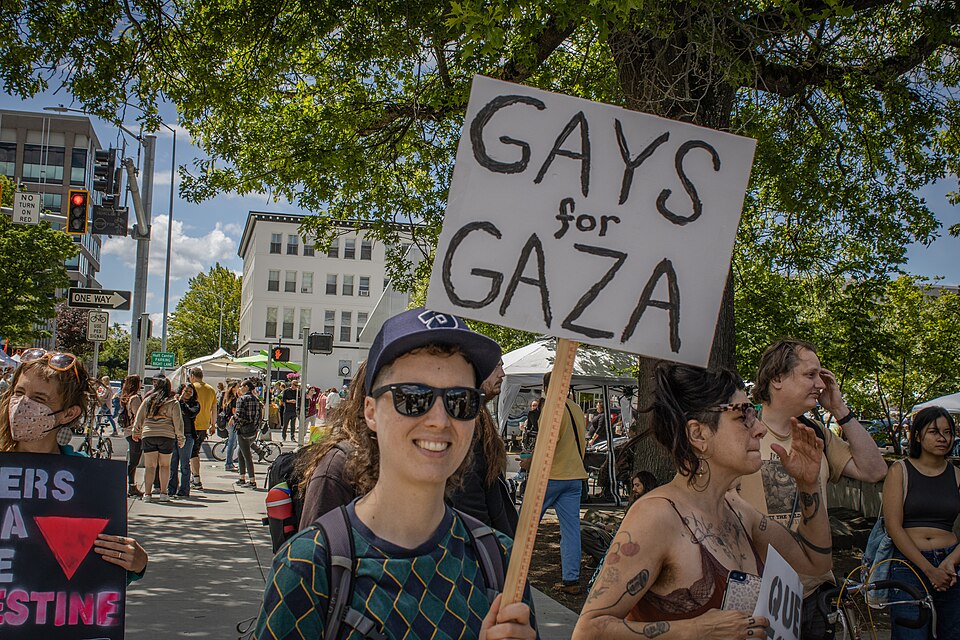
“Pinkwashing” is the antizionist charge that Israel uses LGBT rights to distract from its conduct toward Palestinians. The word did not begin with Israel. Breast Cancer Action says it coined the term through its Think Before You Pink campaign to describe companies or organizations that wrap themselves in breast-cancer concern while profiting from products linked to cancer risk. Anti-Israel activists later adapted the word to Israel, and the adaptation changed the accusation. A real civil-rights difference became evidence of deceit.
The charge does not usually deny that Israel has meaningful LGBT protections. Israel decriminalized consensual same-sex conduct in 1988. Sexual-orientation employment protection followed in 1992. In El-Al Israel Airlines v. Danilowitz, the Israeli Supreme Court recognized same-sex partner benefits in 1994. Israel later recognized some same-sex family rights, registered same-sex marriages performed abroad, and opened surrogacy access to same-sex couples and single men after a 2021 Supreme Court ruling. The dispute is not only over those facts. It is over whether mentioning them is itself suspect.
That is the mechanism of the word. If Israel mistreated gay people, antizionists would cite the mistreatment as proof of cruelty. When Israel protects gay people, the protection is described as public relations. The facts are admitted only long enough to be neutralized. This creates a closed loop: Israel cannot answer the charge by improving the lives of LGBT Israelis, because improvement itself becomes evidence against it.
The Israel-specific use became widely known after Sarah Schulman’s 2011 New York Times essay, “Israel and ‘Pinkwashing.’” Schulman argued that Israeli officials promoted gay rights to distract from Palestinian suffering and from Israel’s rule over Palestinians. Her later book, Israel/Palestine and the Queer International, placed the claim inside a wider activist project. A second route came through Jasbir Puar’s work on homonationalism, which argued that some states incorporate certain gay subjects into national self-presentation while casting Muslim or racialized others as backward or dangerous. Antizionists used that theory to describe Israeli gay rights not as civil rights, but as state power in disguise.
The criticism is not always empty. States brand themselves. Israel has promoted Tel Aviv, tourism, and LGBT rights abroad, and those campaigns can be criticized for selectivity, timing, or tone. Israel also has unresolved problems, including religious marriage rules and social hostility in some communities. A serious critic can say these things plainly. Pinkwashing becomes something else when it treats every Israeli LGBT advance as propaganda, every comparison with neighboring societies as bigotry, and every Jewish or Israeli queer institution as politically contaminated unless it first denounces the Jewish state.
The term also makes Palestinian LGBT vulnerability difficult to discuss. Palestinian LGBT people have faced danger from families, armed groups, police, social hostility, and rulers who do not protect them. In 2019, Palestinian Authority police announced a ban on alQaws activities after threats against the group; after backlash, the ban was reportedly withdrawn. The initial police statement and the threats that followed remain the relevant facts. A movement serious about queer safety would be able to discuss those facts without embarrassment. Pinkwashing language often turns them into forbidden evidence because the comparison weakens the preferred conclusion.
After October 7, the pressure moved from rhetoric to institutional exclusion. ILGA World suspended The Aguda, Israel’s main LGBT rights organization, in October 2024, then announced in May 2025 that the suspension would be lifted effective October 27, 2025 after review. In May 2026, Reuters reported that Rome Pride had barred Keshet Italia, Italy’s only Jewish LGBT group, from joining the parade with a float because the group had not explicitly condemned Israel’s actions in Gaza as genocide. Rome Pride said the event remained open to all who shared its values; Keshet Italia said the decision imposed a litmus test on a Jewish LGBT group. Those cases show the word’s practical function. Pinkwashing begins as criticism of Israeli state messaging, but it can become a rule for disciplining queer Jewish and Israeli participation in public life. Pride groups, universities, arts spaces, unions, and NGOs can be pressured to exclude Israelis or Jews unless they recite the required politics. A movement built around LGBT belonging can end up telling LGBT Jews that they belong only if they detach themselves from Israel.
In its softer use, “pinkwashing” warns against cynical state branding. In its harder antizionist use, it turns Israeli LGBT rights into unusable evidence and makes queer Jewish belonging conditional. The term works by letting a real civil-rights record surface just long enough to brand its very visibility as the deception. That is not analysis. It is a way of making Israel guilty whether it fails gay people or protects them.