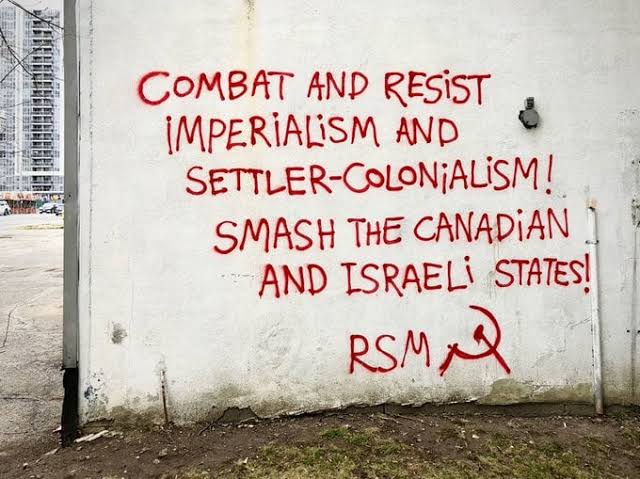
SETTLER-COLONIALISM
“Settler-colonialism” is an academic term for societies in which an incoming population builds lasting communities and seeks control over territory. In Patrick Wolfe’s influential formulation, settler colonialism is not a single event but a continuing structure, and territory is its central object. Settlers come to stay. Lorenzo Veracini later helped formalize the field by distinguishing this form from ordinary colonial rule: the settler does not merely govern from abroad, extract labor, or administer a dependency. He attempts to found a new society in the place itself.
The category is not useless. It directs attention to migration, property, law, institutions, power, and the fate of those already living there. Applied to Israel and the Palestinians, it raises real questions about Jewish immigration, land purchase, British imperial sponsorship, organized settlement, wartime displacement, refugeehood, and the expansion of Israeli communities beyond the 1949 armistice lines after 1967. Those facts should stay in the analysis. Zionism involved settlement, and Palestinians experienced dispossession. The problem is the leap from partial explanation to total indictment.
The fit is uneven from the start. Standard settler-colonial models usually involve an imperial metropole: Britain in Australia, France in Algeria, Spain in the Americas. Zionism had no Jewish mother country. Jews did not arrive as agents of a Jewish empire, backed by a homeland capable of recalling them, funding them, or absorbing the fruits of conquest. They were a dispersed people, often persecuted, legally vulnerable, and stateless. Many came not as representatives of European power but as refugees from it. After the Holocaust, Jewish self-rule was no longer an abstract national theory. It was a question of physical survival.
Nor were Jews foreign to the land in the way the standard model requires. Jewish life there long predated modern Zionism, and Jewish religious, legal, liturgical, and historical memory remained tied to Jerusalem, Hebron, Safed, Tiberias, and the wider land of Israel across centuries of exile. None of that erases Palestinian rootedness. It does mean the conflict cannot honestly be reduced to Europe arriving in a place to which Jews had no prior claim. Two peoples formed attachments to the same land under radically different historical conditions. The slogan has trouble holding both facts at once.
Mizrahi history creates a second problem. A large share of Israeli Jews descend from Middle Eastern and North African communities. Many came from Iraq, Yemen, Egypt, Syria, Libya, Morocco, Tunisia, Algeria, and Iran under pressure, expulsion, dispossession, or fear. They did not arrive as Europeans colonizing the Arab world. They were Jews from the Arab and Muslim world whose own communal histories were ruptured. The antizionist version needs Israel to appear white, European, and alien. Mizrahi history cuts through that image.
The Mandate period complicates the case further. Britain issued the Balfour Declaration and governed Palestine under an imperial mandate, but Zionism was not simply an instrument of British power. British policy repeatedly constrained Jewish immigration, most fatefully in the 1939 White Paper, which restricted Jewish entry into Palestine on the eve of Europe’s catastrophe. Zionist militias later fought British rule. A movement that begins under imperial sponsorship, collides with imperial restriction, and then fights the imperial power does not fit neatly into a single colonial template. The history is entangled, not simple.
The same is true of 1947 and 1948. The UN Partition Plan proposed two states, one Jewish and one Arab. The Jewish leadership accepted the principle of partition. Arab leaders rejected it, and war followed. The war produced Palestinian flight and expulsion, and it also produced Jewish survival against invading armies. A settler-colonial account can describe Palestinian loss; it has far more difficulty explaining Jewish vulnerability, Arab rejection of partition, regional invasion, and the later expulsion or flight of Jews from Arab and Muslim-majority countries. Used this way, the theory selects instead of explaining.
The West Bank is the strongest terrain for the term’s critics. Israeli communities beyond the 1949 armistice lines raise questions of property, military rule, legal inequality, annexationist ambition, and Palestinian self-determination. Those questions should be argued directly and without euphemism. Expansion there is not made more serious by turning all of Israel into a colonial offense, and it is not made less serious by pointing to the failures of antizionist rhetoric. The necessary distinction is between post-1967 settlement policy and Israel’s existence.
The intellectual lineage of the Israel-as-settler-colonial claim is older than its current campus use. Fayez Sayegh’s Zionist Colonialism in Palestine, published by the PLO Research Center in 1965, described Zionism as a racially exclusive settler project. Maxime Rodinson’s Israel: A Colonial-Settler State? developed the argument for Marxist and postcolonial audiences after 1967. Edward Said then helped move the Palestinian case into Western academic language, where Zionism could be described through the categories of European imperialism, Orientalism, and indigenous dispossession. Later settler-colonial studies supplied the vocabulary now common in classrooms, teach-ins, boycott campaigns, and protest statements.
In activist use, that caution often drops away. “Settler-colonialism” operates less as a field of inquiry than as a moral grammar. It arranges the actors before the evidence is weighed: Palestinians as indigenous victims, Jews as foreign settlers, Israel as the colonial structure, and decolonization as the remedy. Once those roles are fixed, the conclusion follows. A settlement can be dismantled. A border can be negotiated. Military rule can be ended. But if Israel itself is the settler-colonial object, then compromise looks like collaboration and Jewish self-rule is marked for removal.
Its usual companions show the point: “decolonization,” “land back,” and “from the river to the sea.” In other contexts, decolonization can mean independence from empire. Applied to Israel in its hardest antizionist form, it often means undoing the only Jewish state. The language does not merely criticize occupation or settlement policy. It casts Jewish national life as a colonial intrusion whose continuation is itself an injustice. That is a far larger claim than a critique of borders, laws, or governments.
The term also changes the moral status of violence. If Israelis are settlers and only settlers, then attacks on them can be redescribed as anti-colonial resistance. Civilian murder is recast as a cost of liberation, not a crime against persons. After October 7, that logic appeared openly in parts of antizionist discourse, where massacres were explained as the inevitable eruption of the colonized against the colonizer. The theory did not require that response, but its activist form made it easier. A vocabulary that turns a whole people into a colonial category weakens the moral barrier against harming them. Used carefully, the term can clarify land acquisition, settlement institutions, territorial control, and Palestinian displacement. Used as antizionist shorthand, it turns a partial explanation into a sweeping charge against Israel itself. The danger is not the category. The danger is the moment a theory about settlement becomes a slogan for removal.