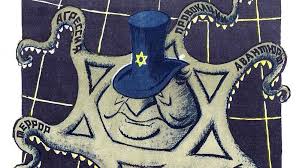
ZIO / ZIONAZI
“Zio” and “Zionazi” are slurs built from the word Zionist. “Zio” is the smaller of the two—a clipped, sneering shorthand that reduces a person to a single political identity and dismisses everything else about them. “Zionazi” is the heavier weapon. It welds the Jewish national movement to the government that murdered six million Jews. The fusion is not an argument; the comparison itself is offered as the proof. Whoever wears the word has already been judged.
Consider what the equation asks a listener to accept. Zionism is a movement for Jewish self-determination. Nazism was the machinery built to exterminate Jews. Calling a Zionist a Nazi erases that distinction and reverses the roles, recasting Jews, or anyone tied to Jewish national identity, as perpetrators of the very crime committed against them. Political disagreement becomes total moral condemnation. The target is no longer wrong; the target is illegitimate. The word draws its power from the most morally charged symbol in modern memory, and it spends that power on a smear.
“Zio” carries a pedigree its current users rarely advertise. The shorthand was a favorite of American white supremacist David Duke and circulated for years in far-right forums before drifting into left-wing activist spaces. By 2016 it had traveled far enough that Britain’s Labour Party commissioned an inquiry into antisemitism in its own ranks. The resulting Chakrabarti Report called “Zio” a “modern-day racist epithet” and recommended that it have no place in party discourse. Jeremy Corbyn—nobody’s idea of an Israel hawk—pronounced it “a vile epithet.” The following year it surfaced among organizers of the Chicago Dyke March, who had expelled Jewish marchers carrying rainbow flags bearing the Star of David. Few words manage to unite David Duke and progressive activists. This one did.
The terms travel through both online and physical spaces, and they surge whenever the conflict does. “Zio” lives mostly in digital exchanges—posts and comments and short-form content on X and TikTok and Instagram, where brevity helps it spread. “Zionazi” and blunt formulations like “Zionists = Nazis” appear in hotter settings: protest signs and graffiti, projections and performance art. The equals sign deserves a moment of attention. It presents the equation literally, as arithmetic—not a claim to be defended but a conclusion to be accepted. Math does not argue, and neither does the sign.
The documented record is not thin, and it is not confined to anonymous accounts. Nazi-comparison signs and banners and projections appeared during the spring 2024 campus encampments at Columbia and NYU and the University of Texas. The most famous cultural example came earlier. At Berlin’s Mercedes-Benz Arena in May 2023, Roger Waters performed in a long black coat with a red armband—an outfit police said resembled an SS officer’s uniform—while firing a prop rifle toward the crowd. Berlin police opened a criminal investigation for suspected incitement, noting that the display could be read as glorifying Nazi rule. Waters called it theater and a critique of fascism. The authorities were unconvinced enough to forward the case to prosecutors, and the image of a rock star in Nazi costume—in Berlin, of all cities—traveled around the world.
The pattern resurfaced in December 2025 at London’s Roundhouse. During an anniversary performance of the album XTRMNTR, Primal Scream played their song “Swastika Eyes” beneath a video that placed a swastika inside a Star of David over the eyes of Benjamin Netanyahu and other political figures. The footage mixed images of destruction in Gaza with the caption “Our government is complicit in genocide.” The Community Security Trust reported the band to the Metropolitan Police, and the venue apologized for imagery it called highly offensive. The band defended the video as “a piece of art” meant to provoke debate, then quietly dropped the graphic from later shows. The sequence is instructive: the fused symbol was indefensible enough to retire, yet familiar enough to project onto a London stage in the first place.
Scholars call the deeper move “Holocaust inversion,” and the name is apt. The inversion flips history and morality at the same time. Israelis or Zionists become the new Nazis, and their enemies become the new victims. One of the most documented crimes in human history is converted into an accusation against the descendants of its victims. Jewish suffering is not denied in this move—denial would be cruder. Instead it is repurposed and handed back to Jews as a charge against them, so that the Holocaust stops being a historical event and becomes a weapon of accusation.
The trick works in two ways. First it flattens history, treating fundamentally different things as identical and making proportional judgment impossible. A checkpoint is not a cattle car, and a war against a terror group is not the Final Solution; the equation forbids noticing the difference. Second it implies betrayal—that the lessons of the Holocaust have been reversed by the very people who survived it. The International Holocaust Remembrance Alliance’s working definition of antisemitism lists “drawing comparisons of contemporary Israeli policy to that of the Nazis” among its examples. Some who use the comparison mean it as an expression of outrage, a way of shouting as loudly as language allows. The analogy remains what it is: historically false and inherently dehumanizing. It escalates; it does not explain.
The equation did not bubble up from nowhere. The Soviet Union systematized it after the 1967 Six-Day War, when Soviet presses poured out books and articles and cartoons binding Zionism to fascism and racism. Izabella Tabarovsky has documented that campaign’s scale and its themes from the archival record. The Romanian intelligence defector Ion Mihai Pacepa later described a coordinated KGB effort he called Operation SIG, designed to seed anti-Zionist material across the Arab world, where earlier Nazi propaganda had already prepared the soil. Whatever the precise organizational chart, the output was enormous and its message was consistent: the Zionist is the new Nazi. Mahmoud Abbas’s 1982 dissertation in Moscow, which advanced claims linking Zionism with Nazism, shows how deep the material reached. The man who would later lead the Palestinian Authority wrote his doctorate in that environment.
From there the language migrated into Western activist and academic circles, often detached from its origins but keeping its shape and wording. Scholars have traced how Cold War propaganda was adopted with little modification and persists in present-day argument. “Zio” itself is newer, a shorthand that spread through the online forums of the 2000s—while “Zionazi” carries the older Cold War formula. Both work by reduction, collapsing a person’s identity into an accusation. The persistence of the equation says nothing about its evidence and everything about its usefulness, since a slur that ends conversations will always find users.
What the words accomplish is compression and escalation in a single move. They let a speaker express opposition while stripping the target of legitimacy, shifting the fight from specific policies to total moral condemnation. Complex disputes shrink to good versus evil, and the Nazi comparison slams the door on debate by invoking the one symbol nobody defends. The words also do social work inside polarized movements. Using them signals intensity and belonging—proof that the speaker holds the approved view at the approved temperature. In institutional settings they ignite disputes over free speech and harassment and the limits of acceptable expression. Underneath it all sits the real payoff: if Zionists are Nazis, their claims need no answer. Nobody negotiates with Nazis, and that is precisely the point.