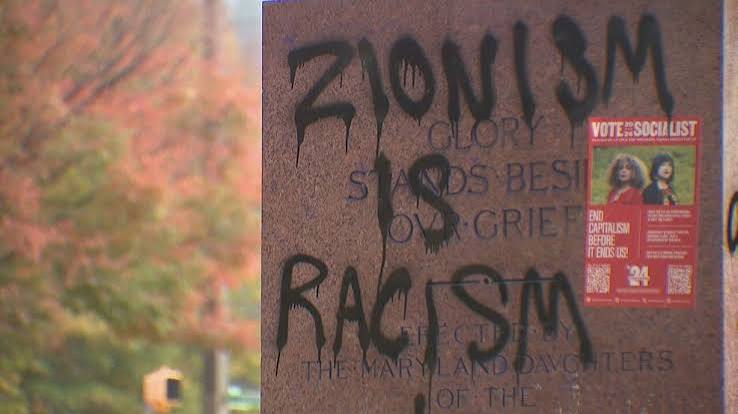
Zionism Is Racism
“Zionism is racism” is a slogan that defines the Jewish national movement as racial supremacy. It does not begin by examining Israeli law, citizenship, elections, Arab representation, peace treaties, security threats, or the history of Jewish persecution. It begins with a verdict. Zionism, the movement for Jewish self-determination in the ancestral land of Israel, is treated as morally equivalent to racial domination. The phrase is not ordinary criticism of Israel. It does not name a border, a coalition, a settlement, a court decision, or a military tactic. It condemns the premise that Jews may exist as a sovereign people. That is why the slogan became one of the most durable antizionist formulas of the twentieth century.
The slogan appears on protest signs, in faculty letters, in student resolutions, in boycott campaigns, and in activist accounts of Israel as an apartheid or settler-colonial state. It also appears in arguments that treat Zionism as interchangeable with white supremacy, fascism, Nazism, or colonial violence. In these settings the word “racism” does not function as a legal finding. It functions as a moral sentence. The phrase gained international prominence after the United Nations General Assembly adopted Resolution 3379 on November 10, 1975. That resolution declared that “Zionism is a form of racism and racial discrimination.” The General Assembly revoked it in 1991 through Resolution 46/86. The repeal removed the resolution, not the slogan. It remained available to campus movements, Soviet-influenced literature, Arab nationalist rhetoric, Durban-era activism, and BDS campaigns.
The implied meaning is that Jewish statehood is uniquely illegitimate. Other national movements may be treated as flawed, violent, complicated, or historically burdened. Zionism is treated as racist by nature. If the premise is accepted, reform is not enough. A racist state by nature cannot be repaired by better policy; it must be dismantled.
The slogan also reverses Jewish vulnerability. Zionism arose because Jews were repeatedly unsafe as minorities under other peoples’ rule. “Zionism is racism” turns that response into the crime itself. It makes Jewish refuge, Jewish power, and Jewish self-defense appear as moral threats rather than answers to centuries of exclusion, pogroms, expulsion, and genocide. The line did not emerge from neutral legal analysis. It belongs to the Cold War history of Soviet, Arab-bloc, and Third World diplomacy against Israel. After Israel’s victory in 1967, the Soviet Union intensified its campaign to portray Zionism as racist, imperialist, colonial, and fascist. Arab states and their allies pushed the same language through international forums. In 1973, General Assembly Resolution 3151G linked Zionism with South African racism and Portuguese colonialism. Two years later Resolution 3379 gave the slogan its most famous official form.
The Durban Conference in 2001 revived and modernized the frame. The NGO Forum there described Israel as a racist, apartheid state and called for measures modeled on the campaign against South Africa. BDS, launched in 2005, drew heavily from that atmosphere. Since then, “Zionism is racism” has traveled as a compressed version of the claim that Israel’s Jewish character is itself a crime. The function of the slogan is to transform Jewish self-determination into a category of racial guilt. It makes the accusation prior to the evidence. Israeli Arab citizenship, Arab parties, Arab judges, minority rights disputes, peace offers, wars launched against Israel, suicide bombings, rockets, hostages, and Hamas’s stated aims all become secondary. The conclusion has already been delivered.
The slogan also creates a social boundary. A person who accepts it is inside the antizionist moral community. A person who rejects it can be treated as defending racism. That structure is especially dangerous for Jewish students and institutions, because support for Israel’s existence becomes evidence of moral contamination. 1. Zionism is a national movement, not a racial theory. Jews are not a race, and Israeli Jews come from Europe, the Middle East, North Africa, Ethiopia, the former Soviet Union, the Americas, and elsewhere.
2. Israel has real inequalities and serious policy disputes. Those facts do not make Jewish self-determination equivalent to racial supremacy. 3. The slogan usually ignores the political rights of Arab citizens of Israel and shifts quickly to the territories because citizenship inside Israel weakens the racial-state claim.
4. Resolution 3379 was repealed in 1991, but its language survived through activist networks and campus politics. It confuses nationhood with race. Zionism argues that Jews are a people entitled to self-determination in their ancestral homeland. That claim can be debated historically and politically, but it is not the same as a doctrine of racial superiority. Calling it racism skips the argument and criminalizes the identity.
It applies a standard rarely applied elsewhere. Many states have national symbols, immigration laws, official languages, religious heritage, and majority cultures. Israel is treated not as one case among many but as uniquely contaminated. That selectivity is the point. It makes coexistence harder. If Zionism is racism, then Zionists are racists, Israeli Jews are beneficiaries of racism, and Jewish institutions that support Israel become suspect. The slogan does not open space for two states or compromise. It pushes the debate toward the end of Jewish sovereignty.